

Tax forms
The affiliates near the US tax threshold view, the conservative $600 tracking threshold, and the year-end CSV export.
When you pay U.S. affiliates through Rekomi, Rekomi (Uplup Inc.) is the payer of record. Year-end 1099-NEC filing is handled through Stripe under Rekomi's name; you do not file anything for your affiliates. What this page covers is the visibility you get on top of that: Rekomi watches each affiliate's year-to-date earnings, flags everyone who could plausibly need a 1099-NEC, and gives you a candidates CSV for your own records and your accountant.
How the underlying tax form is collected depends on the affiliate's payout method. Affiliates paid on Stripe Express provide their tax details to Stripe during Express onboarding (a W-9 for U.S. persons), and Stripe holds the form. Affiliates paid via PayPal (countries Stripe Express does not cover) upload their W-8 directly to Rekomi; their payouts are held until a current form is on file.
The Affiliates near the US tax threshold view
/dashboard/payouts/tax shows every affiliate whose year-to-date earnings, or payments (valued at the USD amount actually paid, the rate locked on each payout line), have crossed the $600 candidate threshold for the current tax year. The view and the CSV export cover the current tax year. Each row:
- Affiliate name + email
- Total earnings YTD
- Tax form status (a Missing badge, or the form type on file: W9, W8BEN, W8BENE)
The payout method and any tax conflicts appear in the CSV export.
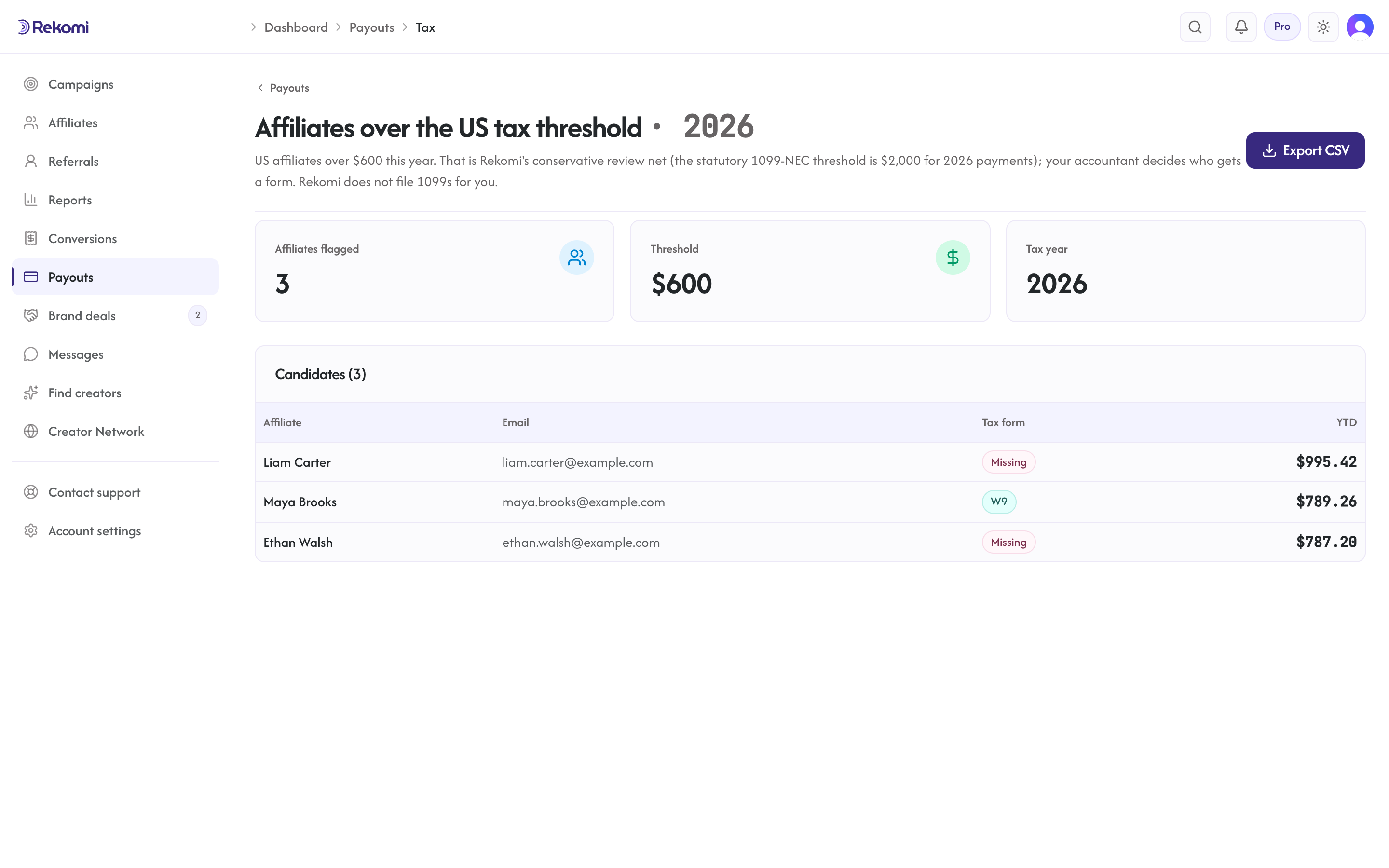
The $600 threshold is deliberately conservative, not a statutory rule. The statutory 1099-NEC threshold for tax year 2026 onward is $2,000, but Rekomi surfaces candidates from $600 so nobody who might need a form slips through, and so brands filing under older or stricter standards are covered. Treat the list as a heads-up: the forms themselves go out through Stripe to the affiliates who meet the statutory threshold.
W-9 vs W-8BEN vs W-8BEN-E
- W-9: U.S. persons and U.S. business entities. Provides the affiliate's TIN (SSN or EIN).
- W-8BEN: non-U.S. individuals. Certifies foreign status.
- W-8BEN-E: non-U.S. business entities. Same purpose as W-8BEN for legal entities.
For Stripe-rail affiliates, Stripe collects the form during Express onboarding. PayPal and bank-deposit affiliates are prompted to pick the right W-8 on /a/settings and upload a signed PDF plus a canvas e-signature.
Where tax forms are stored
Forms uploaded to Rekomi (the PayPal and bank-deposit rails) live in private storage on DigitalOcean Spaces. (Stripe-rail forms are held by Stripe, not Rekomi.) The persisted URL is an opaque marker, never a directly-servable public URL. When you or an authorized admin requests a tax form via GET /api/me/tax-form (affiliate-side) or the appropriate brand-side endpoint, the server mints a short-lived pre-signed URL (5-minute TTL) and returns that. The SSN or ITIN on the form never travels through a public CDN path.
CSV export for your records
From /dashboard/payouts/tax, click Export CSV. The export covers the current tax year and downloads through your signed-in dashboard session, so it needs no extra authentication step. The CSV contains one row per candidate affiliate with these columns:
affiliate_id, email, full_name, tax_form_type, tax_form_status, year_to_date_cents, year_to_date_dollars, rail, latest_tax_form_type, tax_conflict, paid_ytd_cents
How the two money columns are counted: year_to_date_cents is commission earned in the tax year, valued in USD at the reference rate on each conversion's date; paid_ytd_cents is what was actually paid during the year, at the USD amount on each payout line. A payment reversed inside the same tax year (a refund clawed back on or before December 31) does not count toward paid_ytd_cents. A reversal dated in a later year does not reduce it: the payment stays in the year it was made, and the later year's export footnotes the clawback in a # NOTE line rather than netting it against that year's payments. Rows without a USD reference rate for their date (a currency with no usable stored rate) are left out of both totals rather than guessed; the export counts those rows and names the currencies in a # NOTE line at the bottom of the CSV, and the same warning is flagged on the tax page above the candidates table, so the totals can understate until FX coverage is restored.
Deliberately absent: TINs and addresses. The export is a records worksheet, not a filing file, so it never carries an SSN or EIN through your browser or a spreadsheet; the filing itself happens through Stripe, which holds the affiliate's tax form.
A note on full_name: this column is the name the affiliate entered on your campaign's application form, included so the worksheet is readable. It is not the tax identity. The legal name that matters for W-9/W-8 and 1099 purposes lives on the tax form itself or the affiliate's Stripe account, both collected during payout setup, so an informal or edited signup name never affects filing.
Because Rekomi is the payer of record, the 1099-NECs are filed through Stripe at year end; the CSV tells you who is likely to receive one and how much was paid to them, for your records.
CSV formula injection guard
The CSV export prefixes any field that starts with =, +, -, or @ (plus tab and carriage-return prefixes) with a single quote, so spreadsheet apps do not interpret them as formulas. This is a standard defense against CSV injection attacks where a malicious affiliate could embed a formula in their full_name that runs when you open the file. Safe by default.
Retention
Rekomi keeps uploaded tax forms for the seven-year retention window that applies to payer records (26 CFR 1.6001-1). A daily cleanup deletes a form only once it is more than seven years old and no longer needed: superseded forms (a newer form exists for the same affiliate) and forms belonging to anonymized affiliates. The stored file is removed first, then the record. The most recent form of an active affiliate is never deleted, even past seven years.
Erasure is the exception. When an affiliate's account is erased (a GDPR or CCPA deletion request: the affiliate deletes their own account, or you forward the request to support), their tax-form records and files are removed as part of erasure rather than waiting out the retention window. Export the 1099-NEC candidates CSV before a US affiliate you have paid is erased, so your own records stay complete.
Affiliate-side tax form upload
The affiliate's view is at /a/settings. See Affiliates: Tax forms for what they see, how the canvas signature works, and what they can re-upload.