

Last click attribution gives the whole commission to the last affiliate a customer clicked before buying, first click attribution gives it to the first one, and for most affiliate programs last click is the right default. The part I enjoy is that the choice doesn’t change what you pay by a single dollar. It only changes who you pay, so you get to design the incentive without touching the budget.
So I’ll run the same 100 sales through both models, then cover the attribution window, where coupon codes fit, and why your affiliate dashboard and Google Analytics will never agree.
Four calls to make before you touch the setting
- Last click is the default I’d start on, because it pays the affiliate closest to the purchase, it’s the standard rule on most affiliate networks, and it fits in one sentence of your program terms.
- First click earns the switch once one sale in four has two affiliates on it and the last one is usually a coupon or deal site, since that’s where the people introducing your product stop getting paid for it.
- A 60-day window is where I’d start a self-serve product, since the goal is to cover about 95% of the purchases your affiliates start, and the last stretch costs less than you’d think.
- A coupon code should beat a click, because a code typed at checkout is the strongest evidence you’ll ever get of who made the sale.
What does last click attribution mean?
Last click attribution means the most recent affiliate link a customer clicked before buying gets 100% of the commission, and every earlier click gets nothing. Last touch attribution is the same rule under another name in an affiliate program, since a click is the only touch the tracking can see.
Here’s how it works: a customer clicks an affiliate link, the tracking script stores that affiliate’s ID in a first-party cookie on your domain, and the cookie starts a countdown. If a second affiliate’s link gets clicked before the countdown ends, their ID overwrites the first one. When the customer pays, whoever is in the cookie at that moment gets the commission.
That overwrite is literally the whole model, which is the best thing about it. The most common support ticket in any affiliate program is “why didn’t I get credit for this sale?” (I’ve answered that one by hand more times than I’d like), and it’s far easier to answer when the rule is one sentence long.
One thing I’d flag early: “last click” in affiliate software means the last affiliate click, not the last click of any kind. A Google ad clicked afterward doesn’t overwrite anything - and that detail explains most of the reporting confusion further down.
What is first click attribution, and who does it pay?
First click attribution pays the first affiliate whose link the customer clicked inside the window, and later affiliate clicks don’t overwrite it. The cookie gets written once and is left alone until the customer buys or the window runs out.
First click rewards discovery: the YouTuber who made a 15-minute tutorial, the blogger who wrote the comparison, the newsletter that mentioned you first. Those are the people it protects, because their work happens days or weeks before the purchase.
The trade-off is that the affiliate who tipped the customer over gets nothing, and some of those closers are doing real work too. A cashback site with a loyal membership is a genuine reason some people buy today instead of next month. So I wouldn’t call either one the fair model. Each pays for a different job, and both jobs are real.
Last click vs first click: the same 100 sales, paid two ways
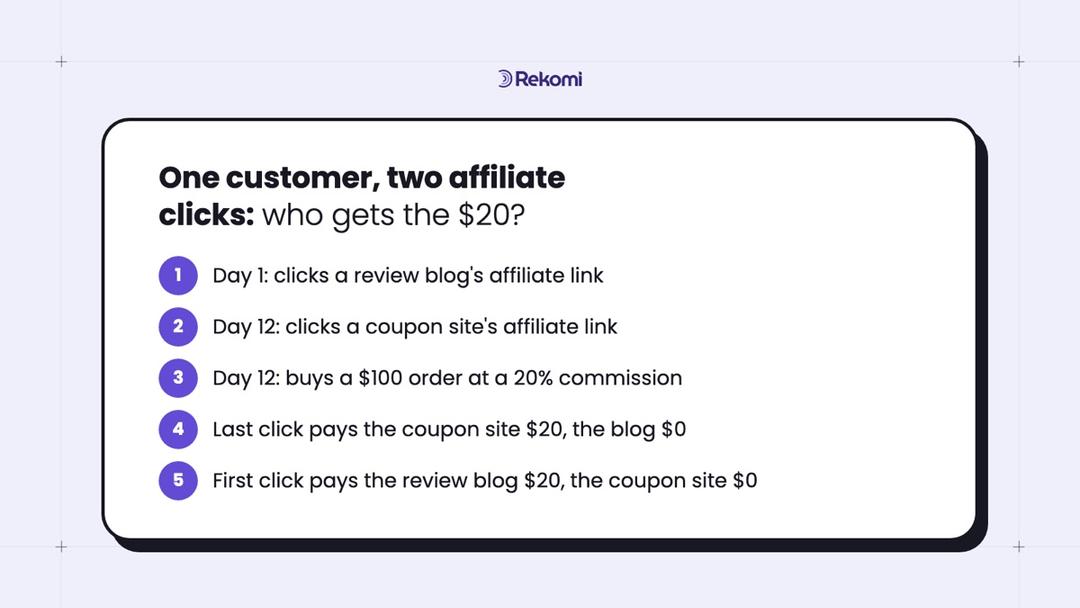
Put one month through both models and the difference shows up in exactly one place. Say your campaign pays 20% on a $100 order, so $20 a sale, and 300 orders came through affiliates this month. On 200 of them only one affiliate was involved. On the other 100, a review blog sent the first click and a coupon site sent the last one.
| Last click | First click | |
|---|---|---|
| Review blog, on the 100 shared sales | $0 | $2,000 |
| Coupon site, on the 100 shared sales | $2,000 | $0 |
| The 200 single-affiliate sales | $4,000 | $4,000 |
| Your total commission bill | $6,000 | $6,000 |
Your bill is $6,000 under both models! The review blog’s month, though, is $2,000 or $0 depending on one dropdown.
I love that the budget drops out of the decision completely. All that’s left to pick is which behavior you want more of next quarter.
So, which one do you want more of? If the blog stops writing about you, those 100 customers probably never hear of you. If the coupon site stops listing you, most of them probably still buy - and at full price. That’s the case for first click in a program where coupon sites sit on top of content affiliates.
In a program with almost no overlap (and that’s most small programs), the setting does nothing at all, and last click wins on simplicity.
How long should the attribution window be?
The attribution window should be long enough to cover about 95% of the purchases your affiliates start, which for a self-serve product is usually somewhere around 60 days. The window is how many days a click keeps counting, and unlike the first-or-last choice, this one does change what you pay.
The math: say 400 purchases a month begin with an affiliate click, and they arrive on this curve (my penciled-in numbers for a self-serve software product, so swap in your own): 88% inside 30 days, 95% inside 60 and 98% inside 90.
| Window | Sales credited | Commission at $20 a sale |
|---|---|---|
| 30 days | 352 | $7,040 |
| 60 days | 380 | $7,600 |
| 90 days | 392 | $7,840 |
Going from 30 to 60 days costs $560 a month and pays for 28 sales your affiliates really did start. Going from 60 to 90 costs another $240 for 12 more. That’s a very small price for an affiliate who never has to wonder whether a slow buyer counted!
Starting points I’d use: 30 days for impulse-priced ecommerce, 60 for self-serve software, and 90 or more when a sales team is involved (the long-cycle version is in my guide to B2B referral programs). Then check it against your own data after a quarter, because your curve is the only one that matters.
Where do coupon codes fit when there’s no click at all?
A coupon code should beat a click, because a code typed at checkout is direct evidence of who sent the buyer and a cookie is only a good guess. Podcast listeners, Instagram story viewers and anyone who hears about you on a phone and pays on a laptop never produce a click on the device where they buy, so the code is the only attribution they can carry.
So the usual order of evidence is code first, then click. If a customer clicked affiliate A’s link on Monday and typed affiliate B’s code on Friday, B gets the sale under either model.
The one place I’d be careful is a public coupon site republishing a creator’s code. The fix there is a line in your program terms plus creator-specific codes, not a different attribution model, and I cover the code side properly in influencer discount codes.
Why do your affiliate dashboard and GA4 never agree?
Your affiliate dashboard and Google Analytics disagree because they answer different questions. The affiliate platform asks “did one of our affiliates send this buyer inside the window?”, and GA4 asks “which of all my channels deserves this conversion?”. Affiliate attribution is the narrower job, and it isn’t trying to be full marketing attribution.
Take one buyer who clicks an affiliate link on day 1, clicks your branded Google search ad on day 9 and buys that afternoon. Your affiliate software credits the affiliate, since theirs was the last affiliate click inside the window. Google Ads credits the ad. GA4 applies its own model, which is data-driven attribution by default (Google’s attribution help page lists the models it still offers, after first click, linear, time decay and position-based were retired in 2023).
That’s three systems and one sale, and each is right about the question it was asked.
What I’d do with that: treat the affiliate platform as the final word on commissions, since that’s what your agreement with affiliates points at, and use GA4 to judge the channel mix. Reconciling the two to the dollar is a week you won’t get back.
How do you set who gets credit in Rekomi?
In Rekomi, both choices live on the campaign, so two campaigns can run two different rules. In a campaign’s settings, under Tracking, there are two fields: “How long a click counts (days)”, which takes anything from 1 to 365 and starts at 60, and “Who gets credit”, which is Last click or First click. The campaign overview then shows both right under the stats, so anyone on your team who opens it can see the rule.
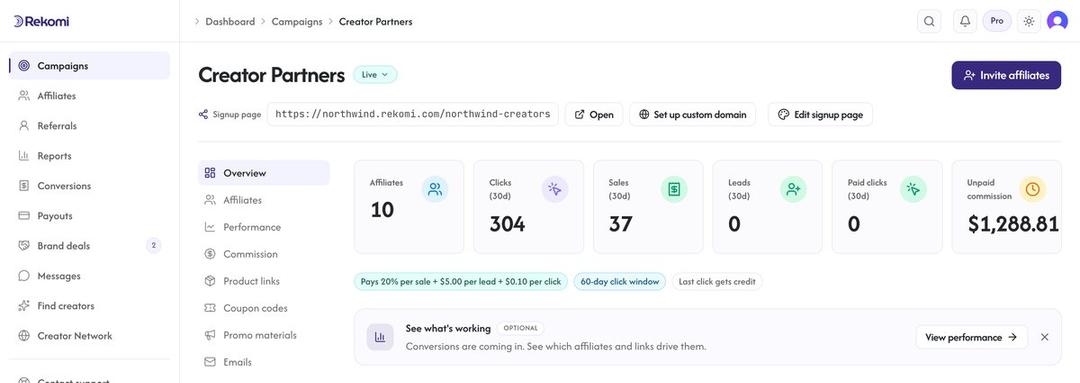
Coupon codes sit on top of that: each coupon has a “Coupon overrides click attribution” switch that’s on by default, so a code at checkout wins over a stored click. Sales are read from your payment processor’s own events, which means a refund reverses its commission in proportion (a 40% refund on a $100 sale with a $20 commission takes back $8).
What it doesn’t do is split credit. One affiliate gets the sale, first or last, and I changed my mind on that more than once before settling: a 60/40 split between two affiliates is defensible on paper, but neither of them can check their share against their own numbers, and a rule affiliates can’t verify is a rule they stop trusting.
Frequently asked questions
Is last click attribution the same as last touch attribution?
Yes. In an affiliate program the two terms describe the same rule: the last affiliate link clicked before the purchase gets the full commission. Analytics tools sometimes use “touch” to include ad views and emails as well as clicks, but affiliate tracking only records clicks and coupon codes, so there the words are interchangeable.
Is first click attribution better for content creators?
Yes, when coupon or cashback sites are active in the same program. First click keeps the commission with the creator who introduced the product, even if another affiliate’s link is clicked right before checkout. In a program with little overlap between affiliates it makes no difference, because most sales only ever have one affiliate click on them.
Is GA4 last click attribution?
No. GA4 uses data-driven attribution by default, which spreads credit across the channels a buyer touched. You can switch reports to a last click model in the attribution settings, but even then GA4 is comparing all of your channels, while affiliate software only compares one affiliate against another.
What is multi-touch attribution in affiliate marketing?
Multi-touch attribution splits one commission between every affiliate who was clicked before the sale, for example 40% to the first click and 60% to the last. Some enterprise platforms offer it as an option. Most programs don’t, because affiliates can’t verify a split against their own click data and the payout statements get harder to explain.
What attribution window do most affiliate programs use?
The windows you’ll see most often are 30, 60 and 90 days, though some large retail programs run far shorter ones. Thirty suits low-priced ecommerce, 60 is a sensible default for self-serve software, and 90 or longer fits products with a sales call. If affiliates keep asking about sales that didn’t count, yours is probably too short.
Does first click attribution stop coupon sites from earning commission?
No. Coupon and cashback sites still earn on every sale where theirs is the only affiliate click, and on every sale where the shopper started with them. First click only moves the shared sales, the ones where a content affiliate introduced the customer earlier in the window, back to that affiliate.
Count last month’s overlaps before you change a thing
Pull last month’s affiliate sales and, for each one, count how many different affiliates had a click on that customer before the purchase. It’s a super quick count, about fifteen minutes, and it settles the question. If fewer than one sale in ten had two affiliates on it, leave the setting on last click and spend the time recruiting instead. If it’s one in four or more, look at who’s first and who’s last, and decide whose work you’d miss.
If you’d like to try both settings on a real campaign, Rekomi’s 14-day free trial is long enough to see a month of overlap, and you can switch between Last click and First click whenever your count says so.
Start a free trial

