

If you’re searching how to find affiliates for your program, the fastest answer is to stop looking outward first: your best affiliates are usually already paying you, and the next best are already sending traffic to your competitors. Everything else works too, networks, communities, agencies and cold outreach to creators included, but it works slower and converts worse than those two, so the order you work the sources in matters more than the number of sources you try. Recruiting is the part of running a program I’d do for fun, because it’s the one job where knowing your own market beats any software.
I’ll take the seven sources in the order I’d work them, and I’ll start with what one active affiliate is worth, because that number decides how much effort each source deserves. Then the two parts most guides skip: how to vet the people who turn up, and what their first thirty days should look like.
Where I’d send the first ten invitations
- Your own customers: the twenty who already mention you in reviews, support tickets or their newsletters will say yes to an invitation far more often than a stranger, and a customer scan ranks a Stripe list for you while you make a coffee.
- The sites already ranking for “best [your category] software”: they have the audience and the buying intent today, and most of them are already affiliates for someone, so the pitch is a better deal rather than a new idea.
- Your competitors’ affiliates: twenty minutes with a search box and their partner page gives you a named list of people who already sell products like yours.
- Your existing affiliates: a one-level finder’s fee of 5% to 15% of a recruit’s commission turns your best partners into recruiters, with no multi-level anything.
What is one active affiliate worth?
On a $49 plan, one active affiliate is worth about $1,372 of lifetime revenue for every month they stay active, and running that number once tells you how many invitations a week to send. The assumptions: your average customer stays 14 months, so each one is worth $686, and an affiliate who is genuinely active sends you two new customers a month. At a 20% recurring commission you pay $137.20 per customer across those 14 months, which leaves $548.80 per customer, and every dollar of it is paid after the money landed!
Now the funnel, with numbers I’d pencil in for a first program (swap in your own after month one): 100 invitations, 25 accept, 8 make a first sale inside 90 days, 3 are still selling at month six. So one affiliate who sticks costs about 33 invitations, and a week with ten invitations in it is a program that adds an active affiliate roughly every three weeks.
I love that the whole recruiting plan comes down to three ratios, because it turns “find affiliates” from a vague wish into a Tuesday-morning task with a count on it. The ratios move a lot by source, which is the point of the order below. Customers accept more often and convert faster because they already know the product. Cold creators accept less often and sell more when they do, because they have the audience. So you spend the warm sources first and the expensive ones second.
How to find affiliates, start to finish
Before any of it, the offer has to be worth saying yes to: a rate the category respects, a cookie window of 30 days or more, payouts on a schedule you can name, and two assets they can use today.
Here’s how it works, whichever source the person came from:
- You pick a source and a shortlist.
- You make an ask that names what’s in it for them: the rate, the cookie window, and how and when they get paid.
- They apply, or accept an invitation.
- You vet and approve them.
- They get their link and a first-sale target with a date on it.
- You nudge them once at day fourteen if nothing has moved.
The step that goes wrong by hand is the first one. Most founders skip the shortlist, email their entire customer list “want to be an affiliate?”, get something like a 3% reply rate and conclude that recruiting doesn’t work. It works fine. The list was the problem.
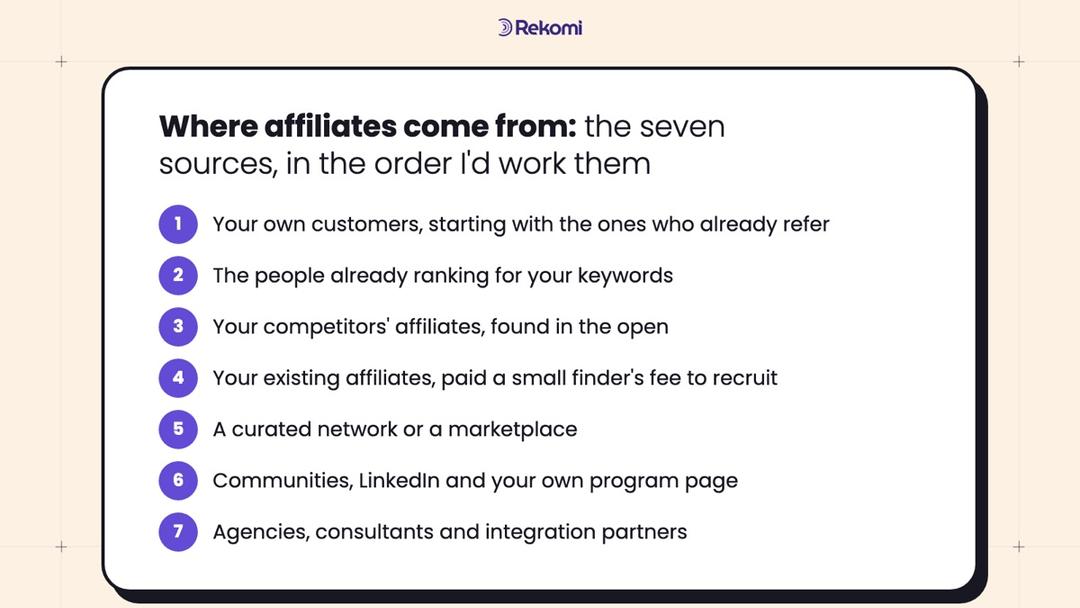
1. Your own customers, starting with the ones who already refer
Your customers are the best source because the two hard parts of affiliate marketing are already done: they trust the product, and the people they’d tell are people like them. Start with anyone who has referred someone organically, left a review, written about you, or runs a newsletter or a channel in your space. Their reply rate to a personal invitation is a different sport from cold outreach.
In Rekomi it goes like this, and the whole thing is a few clicks from scan to send. On the Affiliates page, open Invite affiliates and switch to the From customers tab. Click Run scan and Rekomi reads your Stripe customers and ranks them by how likely they are to make good affiliates, with a short reason next to each pick drawn from their billing history (how long they’ve been a customer, how much they’ve spent and how recently). You tick the ones you want, pick the campaign, edit the invitation message, and send. Nothing is scanned until you click, and nothing is sent without you.
Each person gets a unique invite link, and once they accept and are approved, a one-click “Get your link” email signs them straight into their dashboard. The scan and the drafter sit on the Growth plan and up (the invite modal itself, one address or a paste of up to 50 with an optional commission override, is on every paid plan), and an invitation expires after seven days so a stale one never hangs around.
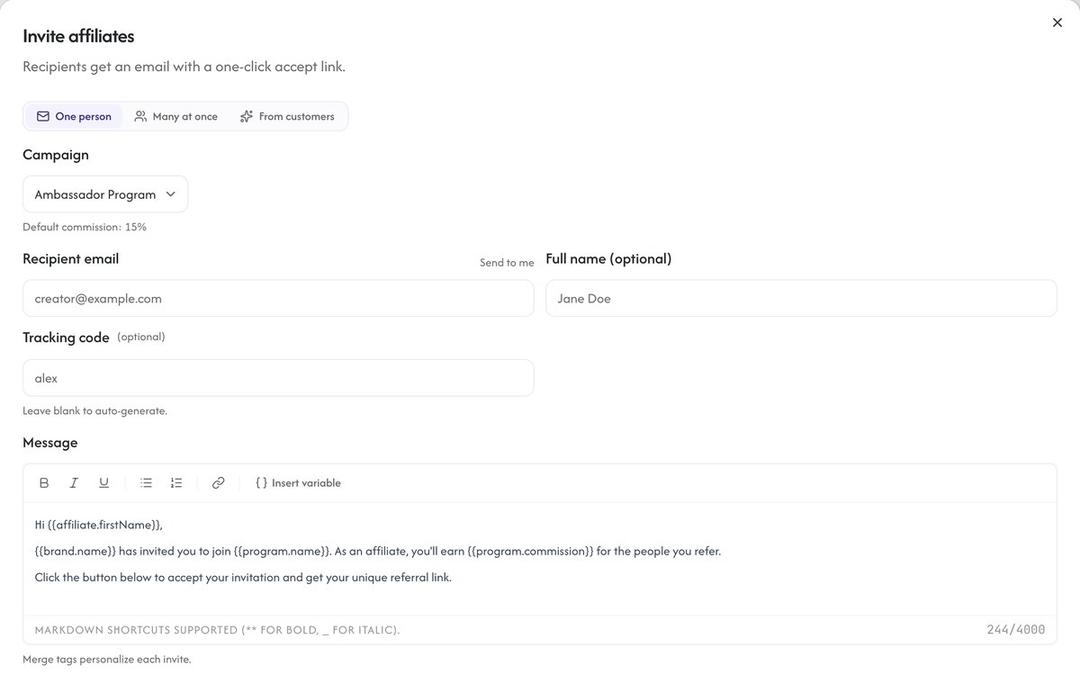
The ask: write it as the founder, name what they already did, as in “you mentioned us in your March newsletter”, state the rate and the cookie window in one sentence, and give them the link. The warm variant in our affiliate marketing email templates is the one to adapt. If you want the whole customer-to-affiliate loop in one place, the AI co-pilot page walks the scan, the ranking and the drafter.
2. How to find affiliate marketers who already rank for your keywords
The second-best affiliates are the sites and channels that already rank for the searches your buyers type, because they have the audience and the intent today and you only need to change which link they point at. Search “best [your category] software”, “[your category] review”, “[competitor] vs [competitor]” and “[competitor] alternatives”, and open the top twenty results plus the top twenty YouTube videos for the same queries. For an ecommerce product, the hashtag search on Instagram and TikTok for your category does the same job.
Most of those pages already carry affiliate links, so you’re pitching a better deal to a professional, not explaining what an affiliate program is. What gets a reply from these sites is a free account plus your honest numbers (the conversion rate on their kind of traffic if you have it, the recurring rate, the cookie window and when payouts go out) and one specific suggestion for where you’d fit on their page.
In my experience about one in ten replies and one in three of those says yes, and the yes is a partnership: a custom rate on the invite, an early look at new features, a quote for their next piece. A creator who ranks for your category is worth more than fifty signups from a directory.
3. Your competitors’ affiliates, found in the open
The question I get most is how to find competitors’ affiliates, and the honest answer is that it’s literally twenty minutes of looking, no tools required. Search “[competitor] affiliate program”, “[competitor] discount code” and “[competitor] promo code”; the coupon sites and review blogs in those results are affiliates.
Then open their links and read the parameters. ?via=, ?ref=, ?fpr=, ?aff= and ?partner= all mean an affiliate link, and the tracking domain tells you which software the program runs on. The competitor’s own partner page often lists featured partners by name, and the descriptions under YouTube reviews are where the affiliate link usually sits.
If you already pay for Ahrefs or Semrush, the backlink report on a competitor’s domain filtered to review and alternatives pages hands you the same list in five minutes – the search box just does it for free!
The ask here is a better deal, never a knock, so lead with recurring commission where they pay one-time, a longer cookie window, faster payouts, tax forms handled, and the option to run both programs side by side, which almost all of them do. Say what’s true about your product and nothing about theirs. The people who switch for a better rate stay for the better payouts, and the ones who badmouth their old program to you will do the same to you later.
4. Your existing affiliates, paid a small finder’s fee to recruit
Your strongest affiliates know other people who’d sell your product, and a finder’s fee gets them to make the introduction. The clean way to do it is a one-level override: when an affiliate recruits someone and that recruit makes a sale, the recruiter earns a percentage of the recruit’s commission, and the recruit keeps their full rate. It’s one level, it’s hard-capped, and nothing compounds. That’s a finder’s fee, and it stops where multi-level marketing starts.
The math: a 10% override, a recruit on a 20% rate, a $100 sale. The recruit earns $20, the recruiter earns $2, and the override comes out of your margin, not the recruit’s pocket. I went back and forth on what to recommend here and landed on 10%, because at 5% nobody bothers to share the link and at 20% the recruit starts asking why their introducer earns that much.
Rekomi has this built in as sub-affiliate recruiting on every plan: you turn it on per campaign, set the override between 0 and 100 percent (5 to 15 is the usual range), and every approved affiliate gets a personal recruitment link in their dashboard, with a live count of who they’ve brought in. Refunds reverse the recruiter’s $2 in the same proportion, a self-recruit is dropped automatically, and the override lands on the recruiter’s tax form like any other commission, so there’s nothing extra for you to file.
One line in your next affiliate newsletter is what gets it used: “we just turned on a 10% recruit-and-earn bonus, your link is on the Recruit page.”
5. A curated network or a marketplace
A network puts your program in front of people who are already looking for programs, which is the opposite problem from the sources above: plenty of volume, less fit. Two things make a network work, and the first is a listing that reads like a pitch rather than a form: who your ideal customer is, who the ideal creator is, why the commission is attractive in numbers, as in “30% recurring, no cap, 60-day cookie, customers pay $99 to $499 a month”, where creators get help, and a press link so they can check you’re real. The second is an approval queue on your side, because the whole value of a network is the volume and the whole risk is who turns up.
Rekomi’s network is curated by people. You list a campaign from the Network page with those fields plus a notes box, a human reads it, and approvals usually land inside one to three business days (a rejection comes with a written reason you can fix and resubmit). Listing needs an active paid plan and a funding source, so every brand a creator sees can pay them. The network is still opening on the creator side, so I’d treat it as the source you set up now and harvest later.
The open alternatives are the marketplaces inside PartnerStack and Reditus for B2B SaaS and the big retail networks for ecommerce. They bring volume fast, and the vetting work moves to you.
6. Communities, LinkedIn and your own program page
Some of the best affiliates find you, if there’s a page for them to find. Every active Rekomi campaign has a public application page on your own branded subdomain, included on every plan, showing the commission, the cookie window, the attribution rule and a short application form; a two-step version asks only for name and email first, so you keep the lead even if they stop there.
People search “[your brand] affiliate program” more than you’d think, so link the page from your footer, your pricing page and your help center. Then put it in the places your buyers already gather: a Product Hunt comment, the Indie Hackers thread about your category, the subreddit where people compare tools. Read the rules first and lead with the program terms rather than a sales line.
LinkedIn works best when it’s you, the founder, posting about the program once a quarter with real numbers from it, which gets the agencies and consultants of source 7 to raise a hand. The application page can also show your verified social accounts with live follower counts, which does a surprising amount of work for an applicant deciding whether the program is real.
7. How to find affiliate partners: agencies, consultants and integration partners
For a B2B product the highest-value affiliates are often not creators at all: the agency that implements your category for clients, the consultant with thirty accounts who gets asked “what should we use?” every week, and the integration partner whose users already have your product in the same workflow. The volume is low, the lifetime value is the highest of any source, and the ask is a conversation rather than an email.
Invite them with a custom rate (the invite carries a commission override for exactly this), give them a demo account they can show, and count them as partners rather than affiliates when you report.
What I’d skip until the program has numbers to show: ads aimed at affiliates, a recruitment agency on retainer and the affiliate summits. All three sell volume, and volume is the cheap part – fit is the expensive part, and the seven sources above are where fit lives.
How do you vet and approve the affiliates you find?
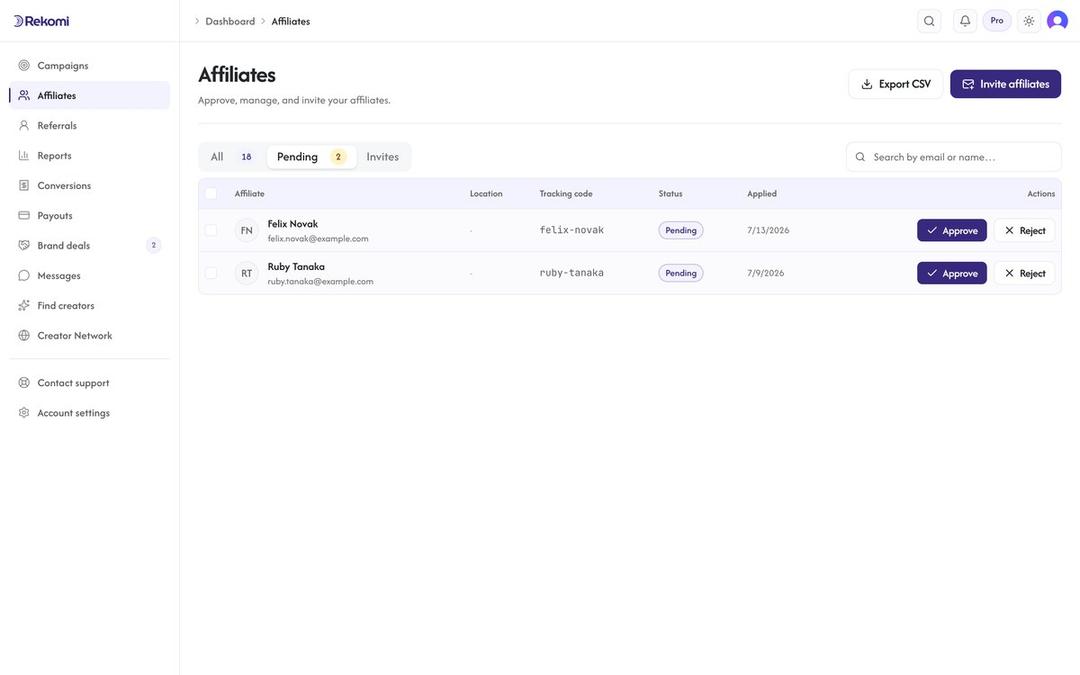
Most advice on how to recruit affiliates stops at the application, and the approval is where the quality of a program is really set. Vetting is reading the application against the one question that matters: can this person put the product in front of people who’d buy it? The form answers most of it when it asks the right things, so collect a website or channel, how they plan to promote you, and their audience. In Rekomi the form takes whatever you want to ask (13 field types, so a social handle or a promo-code preference is a click), and every answer can land in a sheet or your CRM if you want to route applications.
Auto-approve decides how much work this is. On, applicants get their link on submit, which is right when you trust the audience and want zero friction; off, they wait in a Pending queue where you approve, or reject with an optional reason the applicant can be sent. I’d run the queue for any program paying per lead or per click and for anything with a coupon component, and auto-approve for a customer-only referral campaign, where the audience is 100% people you already know.
The red flags are consistent across every program I’ve seen: a coupon site applying to a SaaS program, no audience anywhere, and anyone whose plan is to run ads on your brand name.
What should the first thirty days look like after they join?
Recruiting an affiliate is cheaper than replacing one, so the first thirty days are part of affiliate recruitment. On day one they get their link, the two assets that actually convert, one comparison page and one screenshot or short video, and a first-sale target with a date.
On day fourteen, anyone with clicks and no sale gets a note with one specific placement idea, and anyone with no clicks gets a different note asking what’s in the way. On the first sale they get a congratulations the same day, because an affiliate who has been paid once behaves completely differently from one who hasn’t.
The templates post above has all three emails written. Rekomi sends the commission-earned email when you switch it on under the campaign’s Emails tab and pays out on the schedule you set, which removes the part of this that people forget.
Frequently asked questions
How do I find affiliate marketers for my product?
Start with your customers who already refer, review or write about you, then the sites and channels ranking for “best [your category] software” and “[competitor] alternatives”, then the affiliates visible on your competitors’ partner pages and coupon results. Those three sources produce most of the affiliates who sell, and they cost nothing but a few afternoons.
Where can I find affiliates for free?
Your customer list, your own public application page, the communities your buyers already use, and the people ranking for your keywords all cost nothing but time. A one-level recruiting bonus for existing affiliates costs only when a recruit makes a sale. Networks and marketplaces usually sit behind a plan or a fee.
How much commission attracts affiliates?
A rate in the range the category pays, recurring where the product is a subscription, is what gets a yes; for subscription products the usual range is 20% to 30% recurring. Pair it with a cookie window of 30 days or more and payouts on a schedule you can name, because a higher rate rarely beats a payout on time.
How many affiliates do I need?
Fewer than you think: ten affiliates who each send two customers a month beat two hundred who signed up and went quiet. Plan on roughly a third of accepted affiliates making a first sale inside ninety days and a third of those still selling at month six, then recruit at the pace those ratios need.
How do I find super affiliates?
Super affiliates find programs rather than the other way around, and they look for recurring commissions, a long cookie window, payouts on a reliable schedule and a founder who answers. They’re the sites and channels on page one for your category today, so pitch them as partners: a custom rate, early access and a direct line.
Should I pay affiliates to recruit other affiliates?
Yes, with a one-level override of 5% to 15% of the recruit’s commission and nothing deeper. The recruit keeps their full rate, the recruiter earns a finder’s fee only when a sale lands, and the chain stops at one hop, which keeps it a referral bonus rather than a multi-level scheme. Announce it once or nobody uses it.
Your first ten invitations, today
Open your customer list, sort it by tenure, and pick the ten people who’ve been with you longest and have ever said a kind word about the product. Send each of them the warm invitation with the rate and the cookie window in one sentence, and put a reminder in your calendar for fourteen days from now. That’s a recruiting program, and it took less time than reading this.
If you’d rather have the list ranked for you, the customer scan on the Affiliates page does it on the Growth plan’s 14-day free trial, and nothing goes out until you say so.
Start a free trial

