

The best referral program software is the one that matches how you bill and how you want the reward to reach your customer, because those two things decide what a referred customer costs you far more than any widget does. Every tool below can put a “refer a friend” link in front of your customers. Where they differ is the reward itself (store credit, a free month, cash or a gift card), the event that earns it, who actually moves the money, and what the vendor charges on top. That’s the part of this category I genuinely enjoy comparing, so that’s what I scored.
Below are nine tools with their live November 2026 prices, one worked example on a $49 plan that shows what each reward type really costs, and a table that gives who moves the money its own column.
Where I’d start, depending on what you sell
- A subscription product or an online store: Rekomi rewards the referrer with a free month of their own plan on your billing platform, or store credit on every referred order for Shopify, Wix and BigCommerce stores, so there are no payouts and no tax forms at all, from $29 a month after a 14-day trial.
- A Shopify brand that wants cash or coupon rewards: ReferralCandy is $39 a month plus a 10.5% success fee on a referred customer’s first three orders, with gift cards sent for you through Tremendous.
- A service business or a B2B company with a CRM at the center: Referral Rock is a flat $250 a month with no commission on the rewards you pay, through Tango, PayPal or Wise.
- An app where every member can refer: GrowSurf starts at $179 a month for 2,500 participants, blocks fraudulent referrals automatically and includes tax-form collection and 1099 filing on its entry plan.
What does referral program software actually do?
Referral program software, which the category pages also call referral marketing software, turns your existing customers into a channel: each one gets a personal link or code, the software notices when a friend they sent becomes a customer, and it delivers a reward to one or both sides. It’s a close cousin of affiliate software with one real difference: the people doing the referring already pay you, so the reward can be your own product instead of cash, and the trigger is usually a friend’s first purchase rather than every sale forever. I wrote up the full split in affiliate marketing vs referral marketing, and if you’re still designing the program itself, how to set up a referral program covers the eight steps.
So, what should the software take off your plate? It should take the links and codes, the attribution, the qualifying rules, the fraud checks, the reward delivery and the reporting. If you end up with a spreadsheet for any of those, the tool isn’t finished, and what you bought is referral tracking software rather than a referral program.
How does a referral earn its reward?
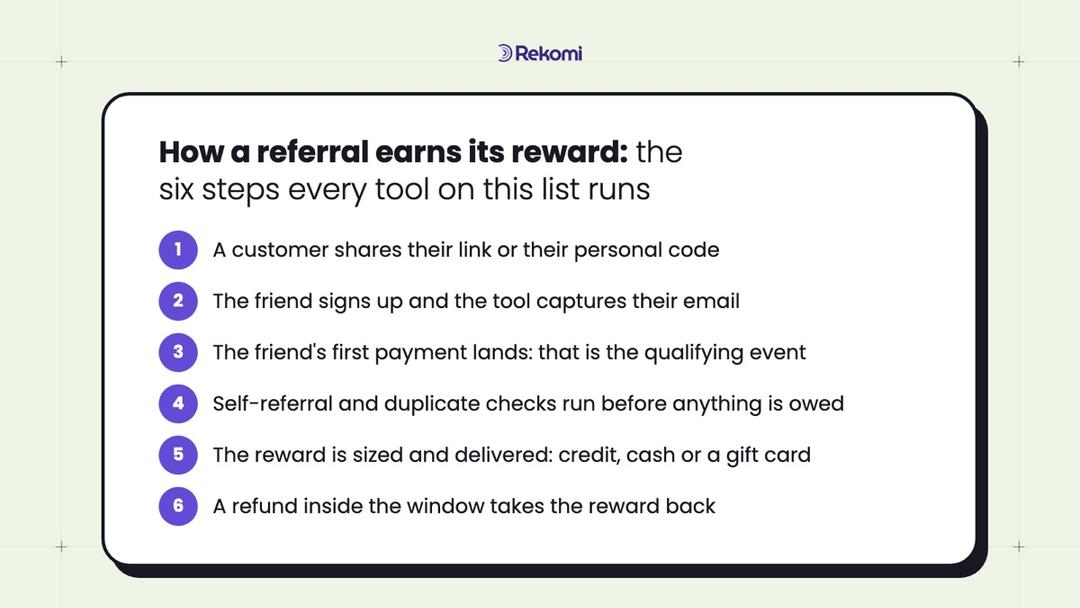
Here’s how it works, on every tool in this list, with the names changed:
- A customer shares a personal link or code, from a widget, a portal page, an email or inside your app.
- The friend lands and signs up, and the software captures the friend’s email (or sets a first-party cookie) so the two can be matched later.
- The qualifying event happens: a first paid order, a first invoice or a signup, whichever you chose.
- The software checks that the referral isn’t the customer referring themselves, a duplicate, or a burst of signups from one IP, and holds it for the review window you set.
- The reward is sized and delivered: credit on the customer’s account, a coupon for the friend, a gift card email or a cash payout.
- A refund inside the window reverses the reward, or flags it if it was already spent.
Step 5 is where a referral program quietly dies when it’s done by hand. I’ve watched teams run a lovely referral page and then fulfill the rewards from a spreadsheet at month end, so the friend got their discount instantly and the referrer waited six weeks for a gift card and told nobody else. The software you want closes that gap the moment the qualifying event lands, and the reward type decides how hard that is – a credit on an account you already bill is the easiest thing in the world to deliver, and a cash transfer to someone whose bank details you don’t have is the hardest.
The reward math: what a referred customer really costs
Run it on one realistic product and watch what moves. Say you sell a $49 a month plan and the average customer stays 14 months, so a new customer is worth $686 in revenue.
The Rekomi free month, made two-sided with a 20% coupon: the referrer gets one month of their plan as a credit, which is $49 off their next invoice, and the friend gets a 20% first-month coupon worth $9.80. Your cost per referred customer is $58.80, and all of it is literally a smaller invoice rather than money leaving your account, and you’ve earned it back inside the friend’s second month! The software is a flat $29 a month on top, and because a credit never enters a payout, there’s no percentage on it.
Two-sided $25 gift card each, Referral Rock through Tango: $50 in cards plus Tango’s 3.5% if you fund by card, which is $1.75, so $51.75 per referred customer, paid in cash up front. The platform fee is a flat $250 a month, which is $12.50 of software per referral at 20 referred customers a month and $2.50 at 100.
Cash the affiliate way, ReferralCandy Basic on a store: a $10 cash reward to the referrer costs $10.54 with PayPal’s 5.4% sending fee, and ReferralCandy’s 10.5% success fee on the referred customer’s first three orders adds $15.44 on three $49 orders, so about $26 per referred customer plus the $39 base. The percentage model is cheap while the program is small and climbs as it works, which is exactly why ReferralCandy’s higher plans trade a bigger base for a smaller percentage.
Same customer, same lifetime value, and the cost per referral reads about $26 with a $10 cash reward, about $52 in gift cards and about $59 in margin, with the software anywhere from $0.29 a head, which is Rekomi’s $29 spread over 100 referrals, to $12.50. I love that the whole spread comes down to two decisions, the reward type and the fee shape, and you can see it before you’ve opened a single feature list.
How I compared the nine referral tools
I scored every tool on the same six things, in the order they start to matter once the program is live: who can refer, which rewards it supports, how the reward gets delivered and who moves the money, what it hooks into natively, what it does about fraud before a reward is owed, and whether the price is flat, per participant or a percentage. Every number below was read from the vendor’s live pricing page and help center on November 9, 2026, every per-customer figure was recomputed on the $49 example, and a page that doesn’t state how payouts or taxes work is reported as silent rather than filled in.
Nine referral tools on one page
The table is the short version of the entries below, and one thing it shows at a glance is that the two tools with no plan names, Friendbuy and Extole, are also the two with no public trial, so the enterprise end of this list is a conversation before it’s a price.
| Tool | Built for | Entry pricing (live, Nov 2026) | Who sends the reward | Native hooks |
|---|---|---|---|---|
| Rekomi | Subscription products and online stores | $29/mo after a 14-day trial; 3% only on cash commissions paid out | Rekomi applies credit on your billing platform or store; pays cash in 130+ countries with tax forms handled | Stripe, Chargebee, Recurly, Paddle, Braintree, Lemon Squeezy, Dodo Payments, Mollie; Shopify, Wix, BigCommerce, WooCommerce |
| ReferralCandy | Shopify and ecommerce brands | $39/mo + 10.5% of a referred customer’s first three orders; 7-day trial | ReferralCandy, through PayPal (5.4% fee) or Tremendous, billed on your invoice | Shopify, WooCommerce, BigCommerce, Squarespace, Recharge, Klaviyo |
| Referral Rock | Service businesses, B2B, ecommerce | $250/mo flat for 10,000 members, no commission; 14-day trial | Referral Rock initiates it from your Tango, PayPal or Wise account | HubSpot, Salesforce, Shopify, Stripe, Chargebee, Zapier, 50+ more |
| Referral Factory | Mid-market teams with large customer bases | $200/mo for 20,000 users; 15-day trial, card required | Paid from your own Tremendous or PayPal account | HubSpot, Salesforce, Zoho, Pipedrive, Intercom, Stripe, Zapier |
| GrowSurf | Subscription apps, fintech, telehealth | $179/mo up to 2,500 participants; 14-day trial | GrowSurf, through PayPal, Wise, Tango or Tremendous; files 1099s for you | Stripe, Chargebee, Recurly, HubSpot, Segment, Zapier, API |
| Viral Loops | Newsletters, startups, fintech, ecommerce | $49/mo (or $35/mo annual) for 1,000 participants; 14-day trial of the Growing plan | You press the button on the lower plans; your own Stripe or Tremendous account pays | Shopify, WordPress, Webflow, Klaviyo, Mailchimp, HubSpot, Stripe, Zapier |
| Friendbuy | Subscription brands, consumer lenders, services | About $750/mo for a Shopify store up to 2,500 orders a month; flat annual license | Shopify discounts and store credit; Tremendous or Tango from your own funded account | Shopify Plus, Adobe Commerce, Salesforce Commerce Cloud, Klaviyo, Braze, Recharge |
| Cello | SaaS products with in-app referrals | From $65/mo (annual badge) up to $10K referral ARR; 0% on user referrals | Cello pays cash daily through PayPal or Venmo and charges your card for it | Stripe, Chargebee, Paddle, Recurly, HubSpot, Salesforce, web and mobile SDKs |
| Extole | Enterprise retail, banks, telecom | No public pricing; demo and quote | Extole fulfills gift cards through BHN; cash from a Tremendous balance you fund | Shopify Plus, Salesforce, Braze, Segment, Klaviyo, Fiserv, SDKs, SFTP |
The 9 best referral program software tools in 2026
I ordered these roughly by who they’re built for, from subscription products and stores through CRM-led businesses to the enterprise platforms, with a pause after every third tool to say what the group has in common.
1. Rekomi
Rekomi runs a customer referral program and an affiliate program on the same tracking engine, and the referral side rewards people with your own product instead of money: a customer shares a link or a personal coupon code, a friend pays a first invoice, and the referrer gets one month of their own plan credited on your billing platform; on Shopify, Wix and BigCommerce the reward is store credit at the commission rate on every referred order instead.
Best for: subscription businesses on Stripe, Chargebee, Recurly, Paddle, Braintree, Lemon Squeezy, Dodo Payments or Mollie, and stores on Shopify, Wix or BigCommerce that would rather reward with store credit than cash, while WooCommerce stores run cash commissions.
Pricing: $29, $49 or $99 a month after a 14-day free trial, with free month and store credit rewards from the Starter plan. Credit rewards never enter a payout run and carry no fee; a campaign that pays cash commissions instead is charged a flat 3% of the commissions paid out.
Standout features:
- The free month is sized from the referrer’s own plan (a yearly plan counts as one twelfth), or you credit what the friend paid or a fixed amount, with an optional cap and an approval hold per credit.
- The friend’s first invoice is the qualifying event, read from the billing platform itself, so renewals never mint a second reward and a full refund of the friend’s first payment reverses the credit while it’s unused.
- Referrers see “Free months earned” on their campaign page and get an email when the credit lands; nobody ever sees a payout screen or a tax form prompt.
- A separate cash campaign for outside partners runs on the same engine, with Rekomi paying them in 130+ countries as the payer of record.
Keep in mind: a credit campaign and a cash campaign are two campaigns, not one toggle, which means the Growth plan at $49 since Starter runs one campaign, and the free month needs a connected billing platform that can carry the credit, so Polar, Creem and Gumroad stay on cash. The split is what makes the math above work: the customer side costs you margin, never a wire.
Bottom line: if your customers already pay you on a platform Rekomi can credit, this is the easiest reward to deliver, because the software sizes and posts the credit itself and there’s no payout step at all.
2. ReferralCandy
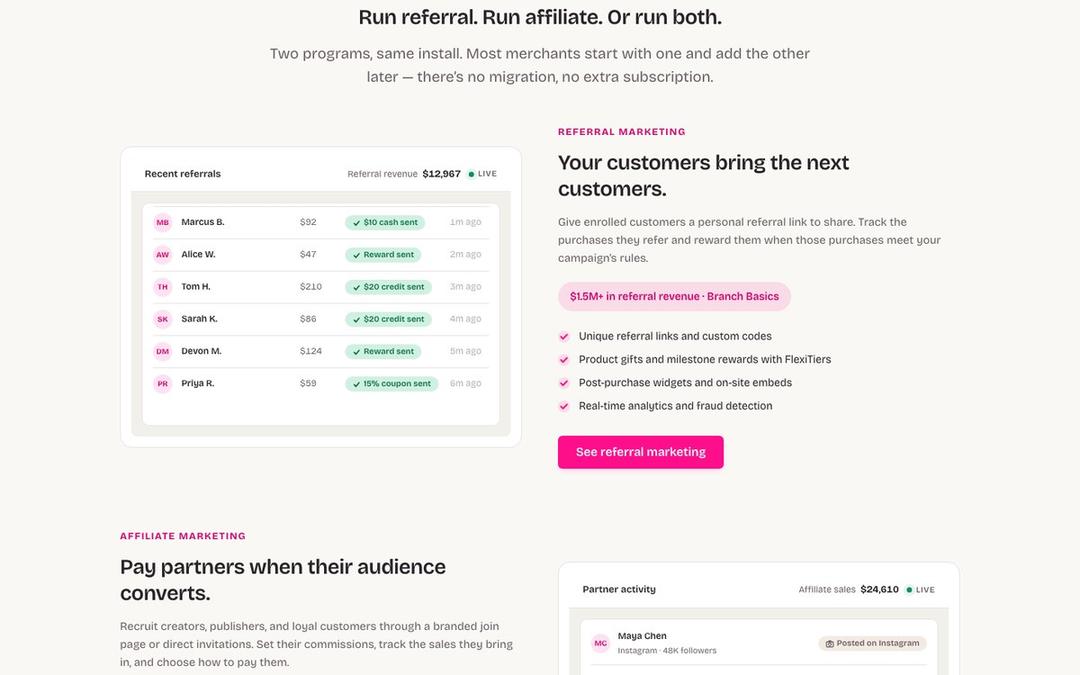
ReferralCandy is the store specialist, built for merchants on Shopify, WooCommerce, BigCommerce and Squarespace, and it has been quietly good at the post-purchase referral widget for years; the newer FlexiTiers give a different reward at each milestone instead of one flat discount.
Best for: ecommerce brands that want referrals and affiliates in one install, with the rewards fulfilled for them.
Pricing: Basic is $39 a month plus a 10.5% success fee, Grow is $79 plus 3.5%, Scale is $249 plus 1.5% and Enterprise is $799 plus 0.25%, all month to month. The success fee is a percentage of the referred customer’s order subtotal on their first three orders only, there’s a 7-day free trial, and trial sales carry no fee.
Standout features:
- Discounts, store credit, cash or gift cards, with cash sent through PayPal or Tremendous and billed on your ReferralCandy invoice, so you never log in anywhere else to pay people.
- A fraud center that blocks exact self-referrals, existing customers and already-referred friends, flags more than three referred purchases from one IP or more than five referrals in a week, and extends the review window to 14 days on a flag.
- Referral and affiliate programs on one install with no second subscription, plus native hooks for Recharge, Klaviyo and Omnisend.
Keep in mind: the success fee stacks on the base price and PayPal cash payouts cost 5.4% of the reward on top, so a cash program on Basic is the most expensive shape in this article per referral. Run the same program with store credit on Shopify and that line disappears.
Bottom line: the easiest start for a Shopify store, as long as you pick the reward type with the fee table in front of you.
3. Referral Rock
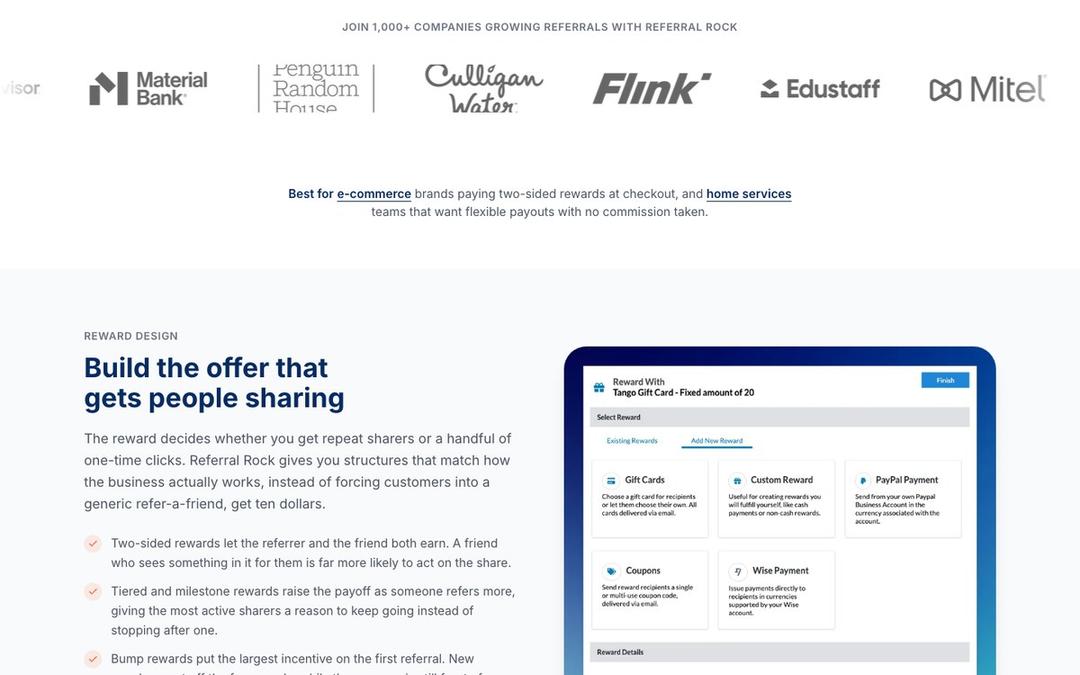
Referral Rock is the tool I’d point a service business at: home services, professional services, B2B companies and multi-location brands, anywhere the referral comes from a happy client rather than a shopper. Its reward engine is the most flexible here, with two-sided, tiered and milestone rewards set once.
Best for: businesses where the CRM is the system of record and a referral has to land in HubSpot, Salesforce or Pipedrive as a lead.
Pricing: the Operator plan is $250 a month, month to month, with 10,000 base members plus 1,000 rolling members free each month, unlimited referrals and no overage fees; annual billing saves 10%. Scale starts at a $25,000 minimum per year and Multi-Org at $1,000 a month. No free plan, a 14-day free trial, no setup fee.
Standout features:
- Gift cards through Tango, cash through PayPal or Wise, store credit, coupons or a fully custom reward, with Referral Rock initiating the payout from the account you connect and taking no commission on it.
- Fraud rules that block self-referrals by email, IP and session cookie, duplicates by email, external ID or phone, and coupon-spam domains, plus a manual review queue for flagged rewards.
- An optional cap of $599 per person per calendar year, which the help center frames as a tax-compliance convenience, and 60 integrations including Stripe, Chargebee, Shopify and QuickBooks.
Keep in mind: $250 a month is the smallest plan, so a program with 30 referrals a month pays about $8.33 of software per referral before the reward, and the help center still names older plan tiers for some payout features. The flat price also means the fee never climbs as the program works, which honestly is the point of paying $250 up front.
Bottom line: when a referral is a relationship rather than a transaction and the reward can’t be a discount code, this is where I’d start.
Three tools in and one thing already stands out: the fee shape tells you who the vendor expects you to be. A flat monthly price, which is Rekomi and Referral Rock, assumes you’ll outgrow it and wants you to; a percentage of referred revenue, ReferralCandy’s model, assumes you’re small and grows with you; a participant cap, the next three, treats your customer base as the asset and prices it directly.
4. Referral Factory
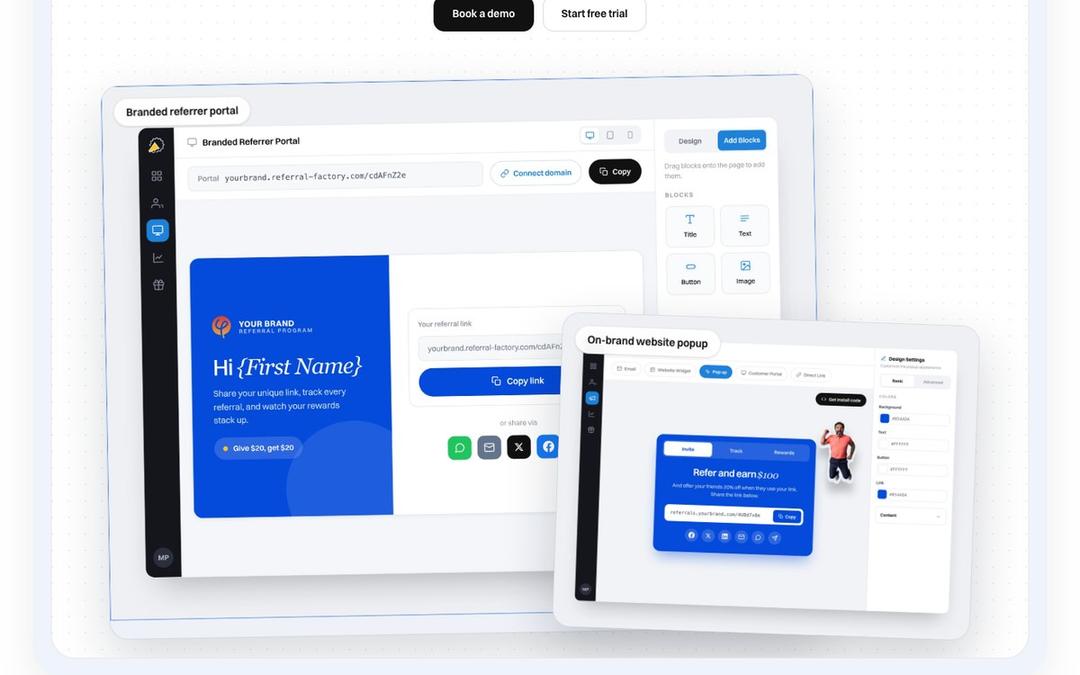
Referral Factory is built for mid-market and enterprise teams with large customer bases, and its builder is the most no-code of the nine: a branded referrer portal, a website popup and the whole campaign assembled from blocks with no developer in the loop.
Best for: sales-led companies that live in HubSpot, Salesforce, Zoho or Pipedrive and want referred leads to land there with the referrer attached.
Pricing: Basic is $200 a month for 20,000 users, Pro is $400 for 40,000 with onboarding included, and Enterprise starts at $1,000 for 100,000 or more. A user is anyone who joins a campaign, referrer or invited friend, extra batches of 100,000 users cost $100, yearly billing is marked 20% off, and the 15-day trial needs a card and charges unless canceled.
Standout features:
- 200+ gift cards in multiple currencies through Tremendous, cash through PayPal, Stripe account credits, coupons and custom rewards for swag or tokens.
- Rewards sit as Due until you click Issue, or auto-issue if you turn that on, which is a sane default for a program that pays cash.
- Qualification rules, reCAPTCHA, email verification and referral limits before a reward exists, same-email self-referrals blocked outright, and a 50% startup discount for companies that apply.
Keep in mind: rewards are paid from your own Tremendous or PayPal account rather than by Referral Factory, the Basic plan carries Referral Factory branding, with white-label from Pro up, and Tremendous can collect W-9 data for you but does not file the 1099s. The upside of paying from your own account is that nothing here is a percentage, so a program that takes off costs the same $200 a month until it passes 20,000 users.
Bottom line: the strongest CRM-native builder in the group, priced for a customer base in the tens of thousands.
5. GrowSurf
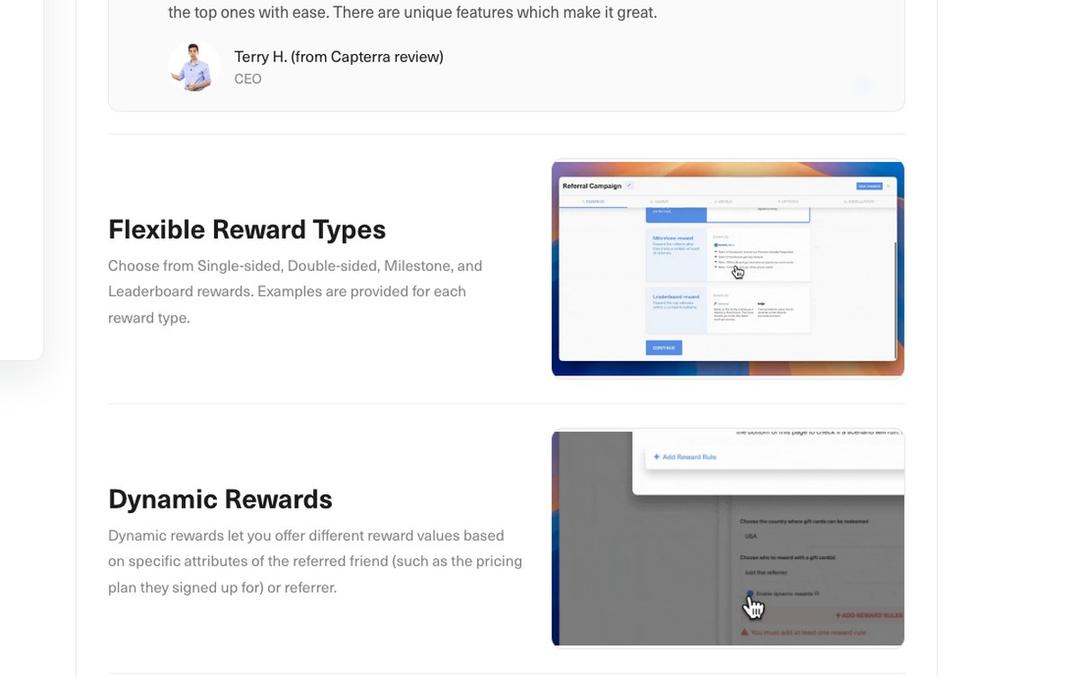
GrowSurf is the developer-friendly one, with a JavaScript snippet, a REST API, webhooks and an MCP server, aimed at subscription apps, fintech, insurance and telehealth companies whose members or users can refer each other.
Best for: product teams that want the referral program inside their own app with the fraud and tax paperwork handled.
Pricing: Startup is $179 a month for up to 2,500 participants or $279 for 5,000, or $1,503.60 and $2,343.60 a year, with two programs and two seats; Business runs from $449 a month for 10,000 participants to $1,429 for 150,000. A participant is anyone who refers or is referred, counted by unique email, and crossing a tier upgrades you and prorates the difference. No free plan on the referral side, a 14-day free trial.
Standout features:
- Automatic fraud blocking that scores identity, timing and behavior, plus disposable-email and data-center IP blocking and an approve-before-send queue.
- Cash through PayPal or Wise, gift cards through Tango or Tremendous, and auto-generated coupon codes for the friend on Stripe, Chargebee and Recurly.
- Tax forms and 1099 filing from the Startup plan: GrowSurf collects the forms, holds payouts until they’re complete and files on your behalf, with the filings charged separately.
Keep in mind: the participant cap counts both sides of every referral, so a program that works moves you up a tier on its own, the Startup plan’s two programs and two seats are tight for a team, and the pages don’t say who funds the PayPal, Tango or Tremendous side. The flip side is that the participant cap is the bill: no percentage on the rewards, and the tax forms are collected on the entry plan, with only the filings charged on top.
Bottom line: if the referral program should live inside your app and the 1099s should be someone else’s job, this is the one.
6. Viral Loops
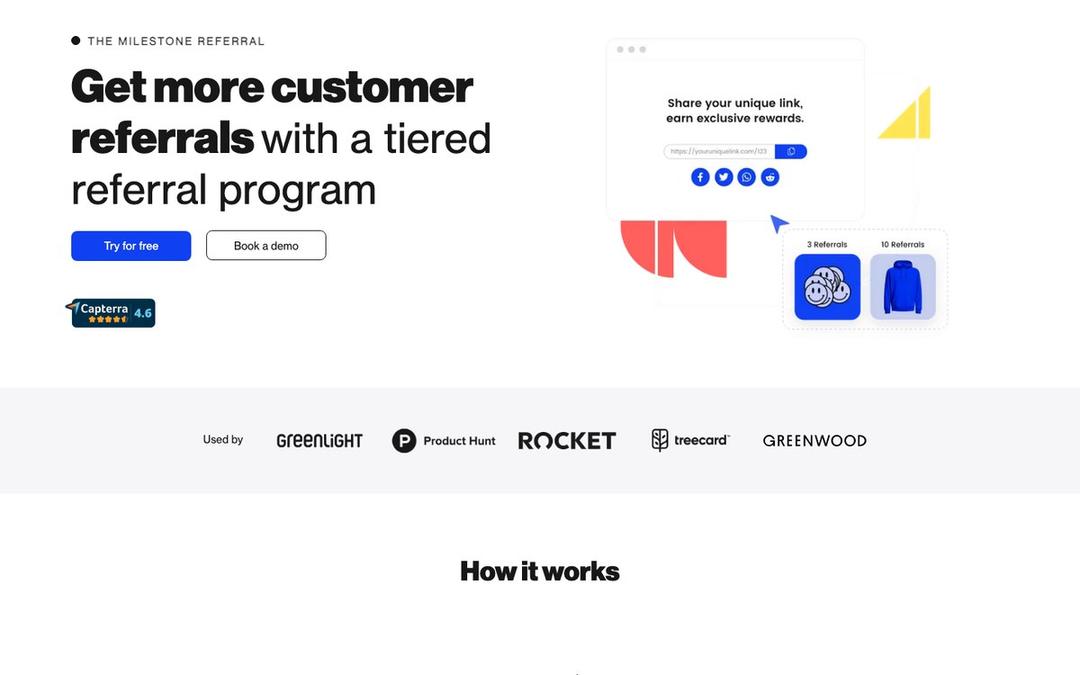
Viral Loops is the template company: a milestone referral, a refer-a-friend, an ecommerce referral or a universal campaign, each one a template you pick and skin, with newsletter creators, startups and fintechs as the named audiences.
Best for: a launch, a waitlist or a newsletter where the referral loop is the whole growth plan and you want it live this afternoon.
Pricing: Start-up is $49 a month, or $35 a month on annual billing, for up to 1,000 participants, Plus is $139 or $99 for 5,000, Growing is $229 or $159 for 10,000 and Power is $399 or $279 for 25,000. Participants are counted uniquely across all your campaigns and the quota never resets. The trial is 14 days of the Growing plan for up to 10 participants, and there’s no percentage fee.
Standout features:
- The Stripe integration sends account credits, coupons and discounts, and the Tremendous integration sends e-gift cards, both on the Milestone and Universal templates.
- Burner-email detection, data-center IP detection, reCAPTCHA, double opt-in and auto-blocking of suspicious referrals, with on-demand AI fraud analysis on the Power plan.
- Integrations across the landing-page world that the other tools here skip, Webflow, Unbounce, Leadpages and Instapage among them, plus a JavaScript SDK, webhooks and an MCP server.
Keep in mind: rewards are triggered by pressing a button in Viral Loops on the Start-up and Plus plans, with automated rewarding from Growing up, and the money comes from your own Stripe or Tremendous account. The pages don’t mention tax forms, and the cumulative participant count upgrades your plan automatically when you pass a limit. The button is also the appeal for a launch: you see every reward before it goes out, which is exactly what you want on a campaign that runs for three weeks.
Bottom line: the fastest route from idea to a live referral campaign, best when the reward is a discount or a gift card and the program has a finish line.
One thing these three show that no pricing page says: Referral Factory and GrowSurf count the friend as a participant and Viral Loops counts everyone who ever joins, and only GrowSurf will file the 1099s on the cash it helps you pay, so the participant count is only half the bill; the other half is whose desk the tax forms land on.
7. Friendbuy
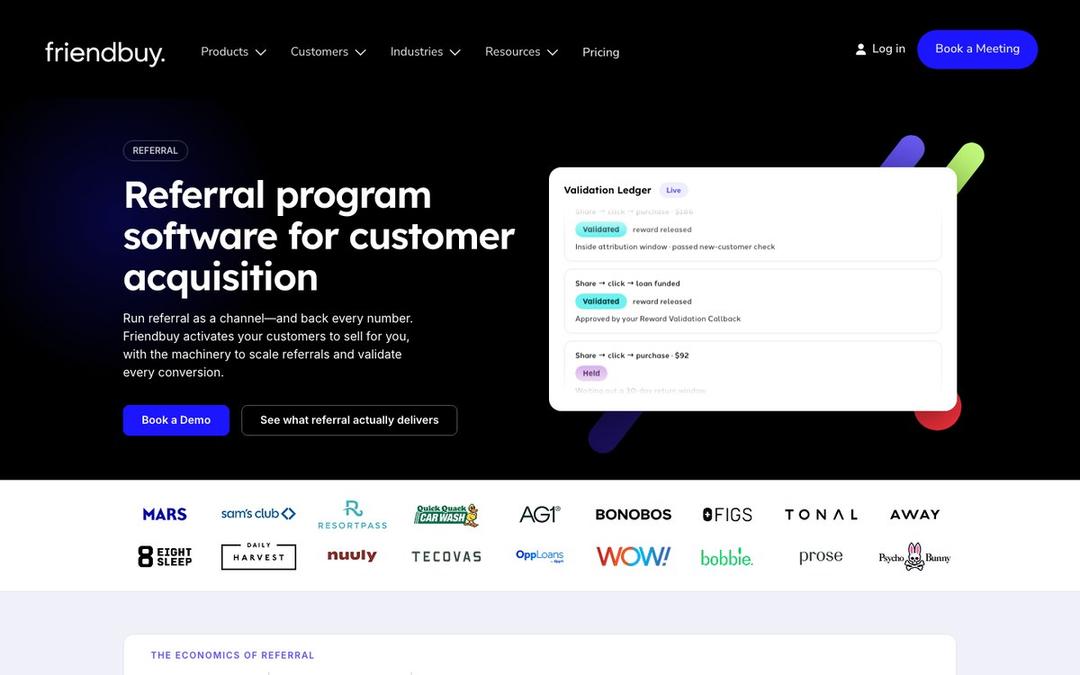
Friendbuy is the brand-side heavyweight for commerce: Shopify Plus, Adobe Commerce, commercetools and Salesforce Commerce Cloud on the store side, Klaviyo, Braze, Attentive and Iterable on the messaging side, and loyalty, referral and influencer programs that share one customer record.
Best for: subscription and DTC brands past a few thousand orders a month that want referrals, loyalty and cashback from one vendor, with the onboarding done for them.
Pricing: there are no named plans; the Shopify calculator shows an estimated $750 a month for a store up to 2,500 orders a month with the referral product, higher tiers up to 7,500 orders and “contact us” above that, and the FAQ calls it a flat annual license with no per-referral commission. Add-ons run from $250 to $500 a month and up, the influencer program adds 2.5% of influencer revenue, and there’s no public trial.
Standout features:
- Coupons and store credit issued natively on Shopify, cashback, gift cards and cash through Tremendous or Tango, and a Rewards Store for custom rewards.
- The deepest fraud rule set in this group: same cookie, IP and user-agent self-referral redirects, same or similar email and same customer ID auto-rejects, a block list, a global reward allowance, velocity controls and a hold for your return window.
- Real-time approval, so your own systems can approve every payout before a reward fires, and a W-9 requirement in Tremendous for anyone passing $600 in a year, once you switch it on.
Keep in mind: this is a sales-led product with a four to six week white-glove onboarding, the cash and gift-card rewards draw from a Tremendous account you fund (an empty funding source means no reward email), and the pages don’t say who files the 1099s. The flat license is the appeal: the fee never moves when the program does.
Bottom line: the enterprise commerce pick when procurement is a feature rather than an obstacle.
8. Cello
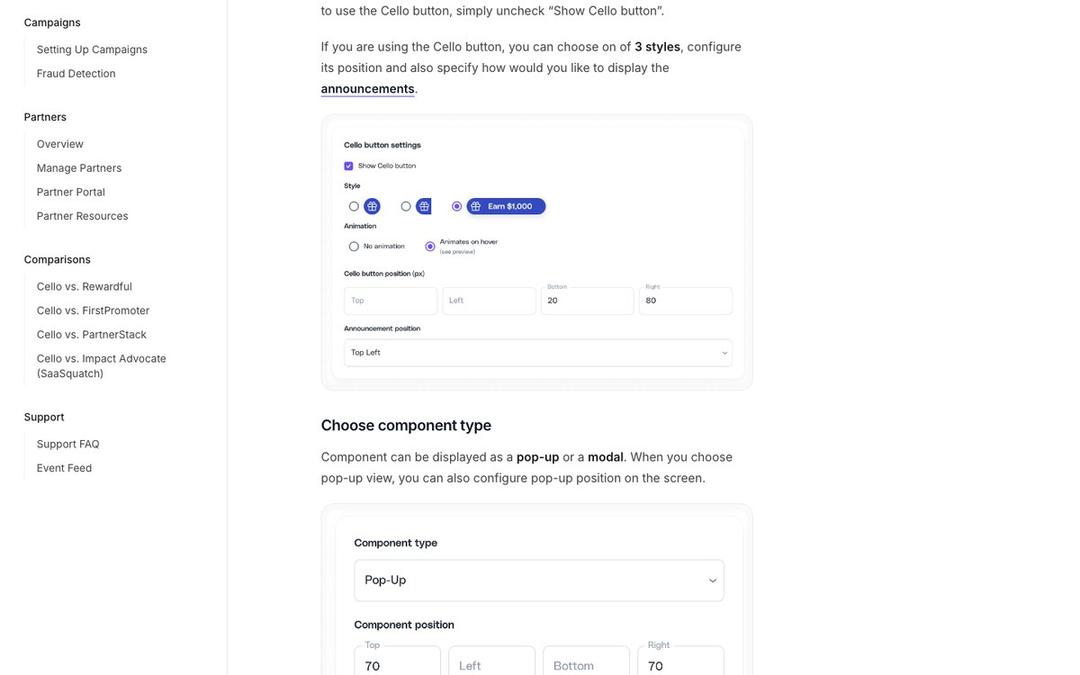
Cello drops a referral component inside your SaaS product, through web and mobile SDKs with Stripe, Chargebee, Paddle and Recurly webhooks on the billing side, and then does something I think is great: it pays the cash rewards to your users itself, daily, and charges your card for them.
Best for: product-led SaaS teams that want a user referral program shipped in hours with cash payouts handled, and don’t mind the vendor running the money.
Pricing: user referrals start at $65 a month on the annual badge for up to $10K of referral ARR with one campaign, Grow is $200 for up to $50K, Scale is $750 billed monthly for up to $100K, and Enterprise is custom, all with 0% transaction costs. The separate partner plans run from free, with five transacting partners and 5% transaction costs, to $280 a month at 3.5%; monthly plans cancel any time and yearly carries a 12-month commitment.
Standout features:
- Payouts to referrers through PayPal, or Venmo in the US, in every currency PayPal supports, with an optional delay such as 14 days before a reward releases.
- Self-referral detection that auto-rejects the certain cases and flags the rest for review, a 30-day review period, and pending rewards that cancel themselves on a refund.
- Up to two charges a month by design, one invoice type for the platform fee and one for the rewards, so the reward spend is its own line.
Keep in mind: cash through PayPal and Venmo is the only reward today and gift cards, donations and product rewards are listed as coming soon, payouts only reach the countries on Cello’s supported list, the pricing page marks its GDPR, CCPA and SOC 2 row as coming soon, and the pages don’t say who handles W-9s or 1099s; Cello’s FAQ puts tax obligations on the referrer.
Bottom line: I’d pick it for a product-led SaaS that’s happy to let the vendor run the money, because its caps are on referral ARR, the one cap on this list that measures what you actually wanted.
9. Extole
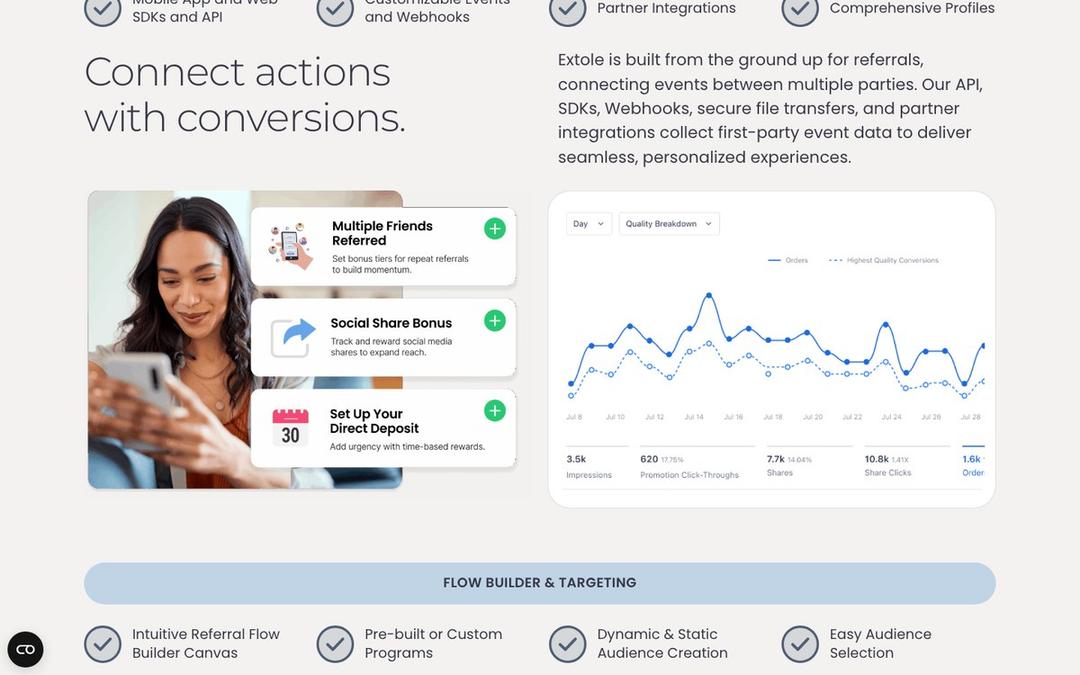
Extole calls itself an enterprise offer management platform, which is accurate: referral, loyalty, influencer and ambassador programs for retailers, banks and telecoms, with a Flow Builder for the rules, a Reward Bank for the inventory of rewards, and SDKs, webhooks, SFTP and a Salesforce Commerce Cloud cartridge for the plumbing.
Best for: a large brand or a regulated business whose referral program needs legal review, audit trails and a vendor team on the other end of the phone.
Pricing: none is published; the pricing URL doesn’t exist and every path leads to a demo request, with no public trial.
Standout features:
- Points, discounts, account credits, global gift cards and cash, with gift cards fulfilled through Blackhawk Network rails and cash through Tremendous.
- Configurable quality rules and risk signals that run before a reward issues, with a review queue for anything suspicious.
- A Reward Bank that holds every reward type the program can hand out, so one program can mix a discount for the friend with points or cash for the referrer, and integrations for the banking and retail stacks: Fiserv, Candescent, Braze, Segment and BigCommerce.
Keep in mind: cash rewards draw on a Tremendous balance you fund with joint access for the Extole team, the pages don’t say anything about tax forms, and a demo-only sale means the price is a negotiation. The upside of a platform like this is that the rules can be as strange as your compliance team needs.
Bottom line: the enterprise choice when the program is one of several offers you run and someone else’s job is the integration.
Line all nine up and they fall into three rows by who holds the money when a reward is due: a gift-card balance you top up yourself, which is Friendbuy, Extole, Referral Factory and Viral Loops; the vendor paying from your card or a connected account, which is Cello, ReferralCandy and Referral Rock, with GrowSurf’s pages not saying who funds it; or a credit on an invoice you were sending anyway, which is Rekomi’s free month, with Stripe credits possible on Viral Loops, Referral Factory and GrowSurf if you size and trigger them yourself. Pick the row you’d rather be in a year from now – two or three names are left.
Which referral software fits your setup?
Start from the system you already run, because that’s the integration that has to be native rather than a workaround.
- You bill subscriptions on Stripe, Chargebee, Recurly, Paddle, Braintree, Lemon Squeezy, Dodo Payments or Mollie: Rekomi credits the free month on that platform with no payout at all; GrowSurf and Cello are the picks if you want cash rewards and a developer-first setup.
- You run a Shopify, Wix, BigCommerce or WooCommerce store: ReferralCandy gets you a discount-and-cash program with fulfillment handled, Friendbuy fits a larger brand that wants loyalty and referrals together, and Rekomi is the pick for store credit on Shopify, Wix or BigCommerce or for cash commissions on any of the four.
- Your customers are clients and the CRM is the system of record: Referral Rock or Referral Factory is the pick, and the choice comes down to how many people will ever touch the program, since Referral Rock counts members and Referral Factory counts both sides.
- You’re a retail or financial enterprise with a procurement team: book the Extole demo, because it’s the only one here built for that buyer and the price is part of the conversation.
- You’re a newsletter or a startup running a launch: Viral Loops is the pick, because its templates and audiences were built for exactly that.
Running referrals and affiliates on one rail
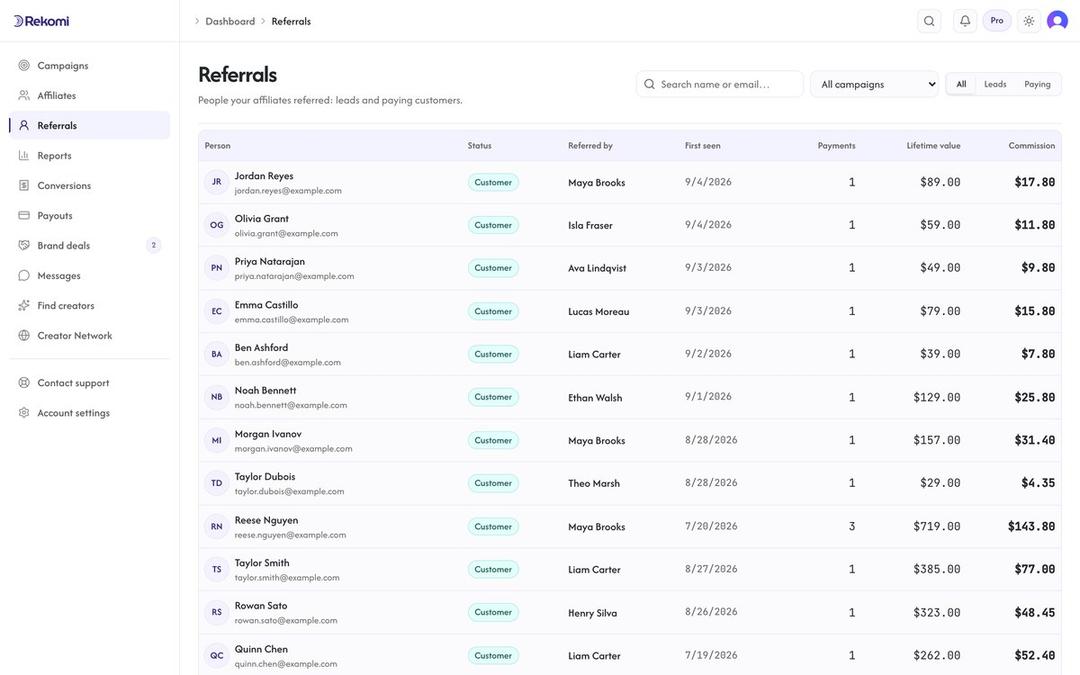
Here’s how I set it up for a subscription product, and it’s super quick, about twenty minutes. One campaign is the customer referral program: the reward is set to a free month on your product, the friend gets a coupon if you want the offer two-sided, and the Rekomi head script with email capture on (one line on your site) is what matches the friend’s first invoice back to the referrer. A second campaign, which is where the Growth plan at $49 comes in because Starter runs one, is the affiliate program for creators and partners who want cash, and Rekomi pays them for you. Every referred customer from both shows up on the same Referrals page with who sent them and their lifetime value, which is the view in the screenshot above, and every free-month credit sits on the Conversions page with its status.
The part worth watching is how little there is to do after the friend pays. The credit is sized from the referrer’s plan, posted on your billing platform, and the referrer gets the email, all before you’ve opened the dashboard! If you want to see it with your own numbers, the free month rewards page walks through the setting and the eight billing platforms it works on.
Frequently asked questions
What is the best referral program software?
The best referral program software delivers your chosen reward with the least friction on the platform you already use. I’d point a subscription product or a store at Rekomi for a free month or store credit, a Shopify brand at ReferralCandy, a service or B2B business at Referral Rock, an app at GrowSurf, and an enterprise retailer at Extole.
What is referral management software?
Referral management software is the same category from the operations side, and referral marketing software is the vendors’ name for it: it generates the links and codes, attributes each friend to the customer who sent them, applies qualification and fraud rules, delivers the reward and reports on it. Every tool here does all five, and the entries say how well.
How much does referral program software cost?
Entry prices run from $29 a month at Rekomi through $39 plus a 10.5% success fee at ReferralCandy, $49 at Viral Loops, $65 on annual billing at Cello, $179 at GrowSurf, $200 at Referral Factory and $250 at Referral Rock, with Friendbuy around $750 and Extole on a quote. The reward itself usually costs more than the software.
Do referral programs work for SaaS?
Yes, when the reward is something a customer already values and the friend’s first paid invoice is the qualifying event. A free month costs you margin rather than cash, pays for itself inside the friend’s second month on the example above, and keeps renewing customers in the program. Cash works too, with a payout path and tax forms.
Do I need referral software, or can I track referrals in a spreadsheet?
No, you don’t need software for the first ten referrals, and yes, you need it right after. The spreadsheet breaks at exactly the steps that matter: matching a friend’s payment to the customer who sent them, catching self-referrals, reversing a reward after a refund and delivering rewards the same day. Those are the steps every tool above automates.
How do you promote a referral program?
Put the share link where the customer already is: the post-purchase page, the first invoice email, the app’s settings page, and one reminder a quarter. Every tool here ships a widget or a portal page for that, and the ones with Klaviyo, Braze or HubSpot hooks can drop the link into your existing emails. A two-sided reward does the rest.
Can my customers and my affiliates be in the same program?
Yes on the same platform, usually as two programs. Rekomi runs a credit campaign for customers and a cash campaign for partners side by side on the Growth plan; ReferralCandy and GrowSurf offer both on one install. Keeping them separate is 100% a feature: customers get product, partners get commission, nobody gets a surprise tax form.
Do the napkin math before you start a trial
Take your price, decide whether the reward is one-sided or two-sided, and work out what one referred customer costs you in each reward type the way the math section does – five lines on a napkin is plenty. The answer usually picks the tool for you, because it tells you whether you want credit, cash or gift cards, and only two or three tools on this list deliver each one cleanly.
If the answer is a free month or store credit, start a 14-day free trial of Rekomi, connect your billing platform or store, set one campaign’s reward to Free month, and run one referral through a second account with a different email. The credit lands on the referrer’s next invoice, and there’s nothing for you to pay out.
Start a free trial

