


The best affiliate management software is the tool that takes the month-three work off your plate: approving the right people, paying them on time in the right country, collecting their tax forms, and catching the one affiliate who is quietly sending junk. Every tool on this list has a lovely signup flow – what separates them is what happens after launch, and honestly that’s my favorite part of this category to watch, because it’s where the software either earns its keep or hands you a spreadsheet. So that’s what I scored, with every price below read off the vendor’s live pricing page on November 4, 2026.
Start your shortlist with these three
- Rekomi pays your affiliates in 130+ countries and files their tax forms as the payer of record, from $29 a month plus 3% of payouts.
- Rewardful is the cleanest pick for a Stripe or Paddle SaaS that runs its own payouts, from $49 a month with a 0% transaction fee.
- Impact.com is the one to book a demo with once affiliates, creators and referral partners share one budget, and its real tiers start at $500 a month.
What is affiliate management software?
Affiliate management software is the system that runs an affiliate program after the links go out: it approves and organizes affiliates, tracks the clicks and sales they send, calculates commissions under your rules, holds them through the refund window, pays them out, collects tax forms, and reports on all of it. Tracking is one part of that job. Management is the whole loop.
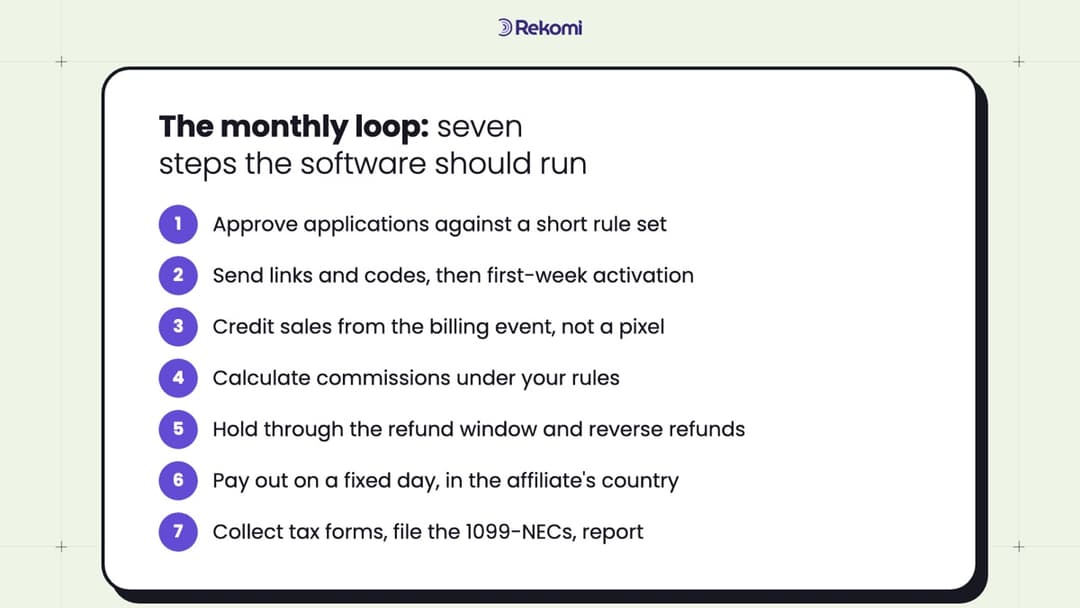
A lot of tools are brilliant at the first half and quiet about the second, and that’s the whole reason this list exists. Here’s how the loop works end to end:
- An affiliate applies and you approve them, or your rules do, and they get a link, a coupon code, or both.
- A reader clicks, and the tool remembers who sent them, ideally in a first-party cookie served from your own domain so an ad blocker can’t eat it.
- A sale lands, and the honest tools read it from the billing event itself, whether that’s Stripe, Shopify, Paddle or WooCommerce, rather than from a pixel that fires on a thank-you page.
- A commission is calculated under whatever rule you set: a percentage, a flat fee, recurring for a set number of months, a lead bounty, a per-product rate.
- The commission waits out a hold so a refund can reverse it before anyone gets paid. This is the step that goes wrong by hand every single time: the payout goes out on the 1st and the refund lands on the 3rd.
- A payout goes out on a schedule, in the affiliate’s country, and someone files the tax forms at year end.
- Reporting tells you which affiliates are earning, which ones are sending refunds, and what you owe next month.
I wrote the long version of steps 2 and 3 in my piece on how affiliate tracking software works, so this article spends its time on steps 1 and 4 through 7, which is where the admin work lives and where the tools genuinely differ.
How I scored the nine affiliate management tools
I read every pricing page and the vendors’ own help pages on November 4, 2026, recomputed every number in the cost table myself, and where a page says nothing about tax forms or fees I say so rather than guessing. Then I asked the same six questions of all nine, and I’d suggest you ask them of whatever you’re running today:
- Tracking integrity. Does it credit a sale from the billing event, reverse the commission on a refund, and keep recurring commissions accurate when a subscriber upgrades or churns? First-party tracking on your own domain is the bar now, not a bonus.
- Who pays the affiliates, and who files the forms. This is the question that splits the list in two. Some tools pay your affiliates for you and act as the payer of record, so the W-9s, W-8s and 1099-NECs are their problem. Others hand you a CSV and wish you luck. I covered the mechanics in how to pay affiliates if you want the detail.
- Fraud and quality controls. Click scoring, duplicate-account checks, a refund hold you can set, and the ability to invalidate a commission without a support ticket.
- The affiliate’s experience. A portal on your own domain, emails from your own address, deep links to specific products, and a dashboard that shows them what they’ve earned without emailing you.
- Honest cost at a real volume. Pricing pages are written to look alike. Run them at a real number and they stop looking alike very quickly, which is what the cost table further down does.
- Fit and migration. Does it talk to your billing platform natively, and if you’re switching, do your existing links and affiliate history come with you?
Judge any affiliate management platform on what it does with a refund and a 1099, not on how fast the first link appears. A tool that gets those two right has thought about month twelve, and that’s the tool you want running your money.
The nine at a glance
Read the last two columns first, because the first three are the ones the pricing pages were written for.
| Tool | Best for | Starting price (live, Nov 2026) | Fee on top | Pays affiliates for you | Tax forms |
|---|---|---|---|---|---|
| Rekomi | Brands that want tracking, payouts and tax handled in one place | $29/mo, 14-day trial | 3% of payouts | Yes, 130+ countries | Yes, payer of record |
| Rewardful | Stripe or Paddle SaaS wanting a fast, clean setup | $49/mo, 14-day trial | 0% (Managed Payouts is an optional add-on) | Self-managed by default | Only with Managed Payouts |
| FirstPromoter | Subscription SaaS that wants deep revenue reporting | $49/mo, 14-day trial | None listed | One-click, or managed on Enterprise | Opt-in collection |
| Trackdesk | Programs and networks that want uncapped affiliates and conversions | $299/mo, 14-day trial | 0% | Through your rails | Not listed |
| Post Affiliate Pro | Teams that want every tracking method and don’t mind manual payouts | $89/mo, 30-day trial | 0% | No, export and pay | Not listed |
| Refersion | Shopify and ecommerce brands with a product catalog | $39/mo | +3% of affiliate-driven sales | One-click incl. PayPal | 1099 support via Unified Payments |
| LeadDyno | Small stores and creators with a long tail of platforms | $49/mo, 30-day trial | 0% | PayPal Payouts, a few clicks | Collection and export for 1099 prep |
| PartnerStack | B2B SaaS running affiliate, referral and reseller partners | Quote only | Not published | Yes | Yes on direct deposit (1099-K) |
| Impact.com | Mid-market and enterprise multi-channel partnerships | $30/mo + 2.5% of revenue | 2.5% on Starter | Yes, 70+ currencies | Ask on the demo |
caption: Prices are the monthly-billed figures on each vendor’s live pricing page as of November 4, 2026. Annual billing is usually cheaper.
The 9 best affiliate management software platforms in 2026
I ordered these by how much of the loop above they run for you, then by cost at a real volume, with a nod to who each one is actually built for.
1. Rekomi
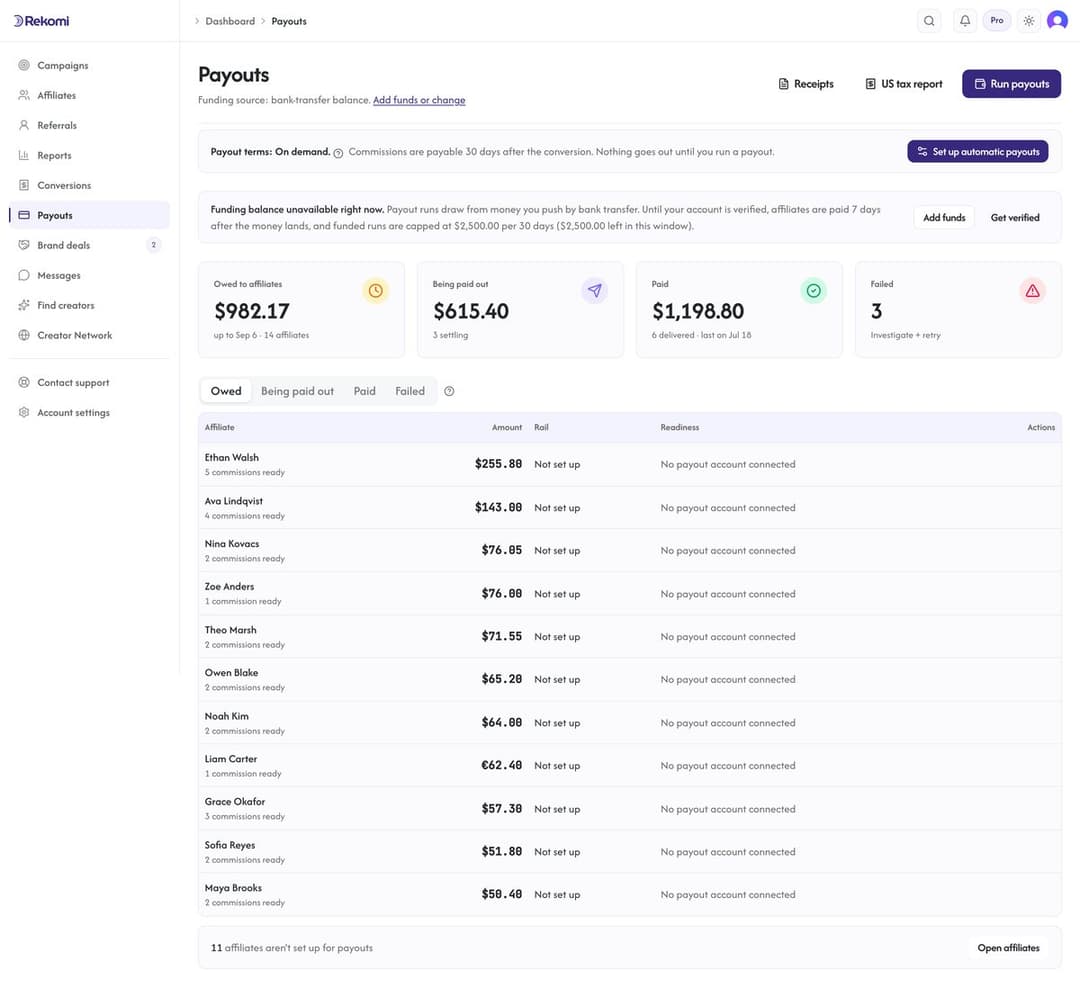
Rekomi is built around the second half of the loop: it pays your affiliates for you in 130+ countries, collects W-9s and W-8s during payout onboarding, and files the 1099-NECs at year end as the payer of record, so the admin that eats a Friday every month is the part the software does. It reads each sale from your billing platform’s own events, and it’s an approved app on Shopify, Wix, BigCommerce and the Stripe App Marketplace, with a WordPress plugin for WooCommerce. A custom domain for first-party tracking is included on every plan, not held back for the top tier.
- Best for: brands of any size that want one tool to track, pay and handle tax, and would rather fund one payout run than manage a dozen PayPal transfers and a spreadsheet of tax forms.
- Pricing: Starter is $29 a month with one campaign and unlimited affiliates, Growth is $49 with unlimited campaigns and the AI co-pilot, and Pro is $99 with a white-label affiliate space on your own domain and multi-currency reporting. Every plan has a 14-day free trial with $0 charged if you cancel, and every plan adds 3% of what is paid out, which is what covers paying affiliates worldwide and collecting their forms. At $5,000 a month in commissions, that’s $150.
- Standout features: automatic payouts through Stripe Express, with PayPal for more countries and a one-click bulk run, so payday is a button; a refund mirror that reverses commissions on its own, plus a hold you can set anywhere from instant to 90 days; per-affiliate coupon codes on Stripe and Shopify that credit a sale with no click at all, which rescues every podcast and newsletter mention; existing links from 20+ platforms keep working after a migration, so nobody re-sends anything; a hosted MCP server, so Claude, Cursor or ChatGPT can run the program by chat.
- Keep in mind: the 3% on payouts is a real line item, so a program paying $50,000 a month in commissions adds $1,500 and should weigh that against running its own payouts. The affiliate network is still opening, so don’t buy it for recruiting yet. And it’s new enough that you’ll judge it on the trial rather than on a stack of review-site ratings, which is honestly how I’d judge any of these.
- Bottom line: if the question that brought you here was “who pays the affiliates and files the forms”, this is the tool where the answer is “the software does”.
2. Rewardful
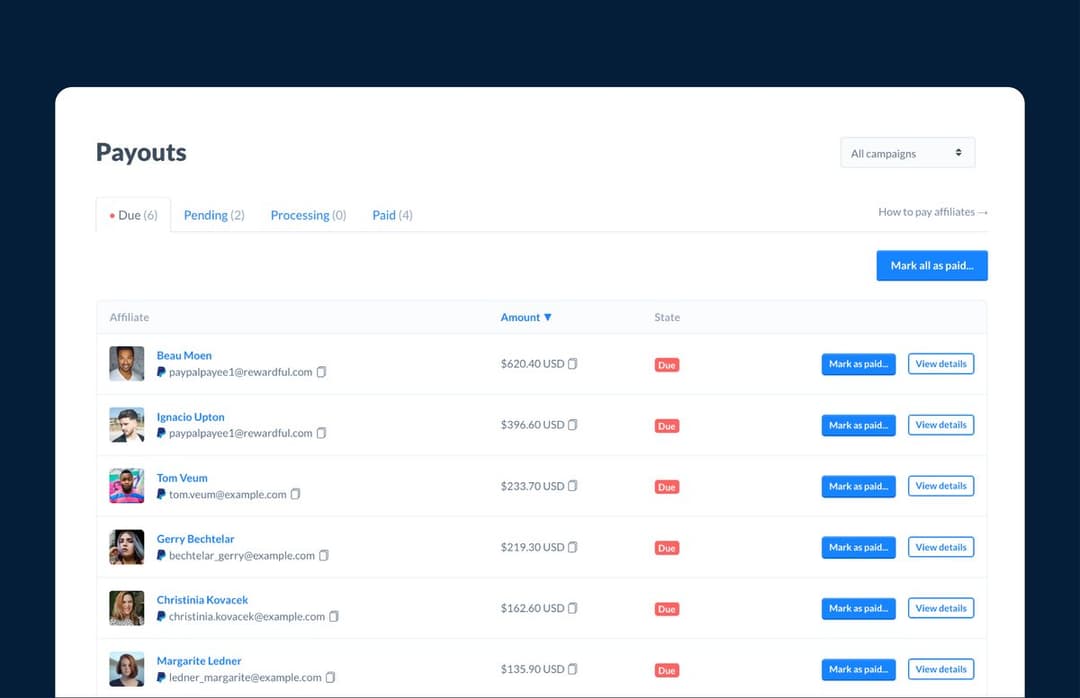
Rewardful is the tool I’d point a Stripe or Paddle SaaS at when the brief is “working program by lunch”, and I mean lunch today. It plugs straight into the billing layer, so recurring commissions, upgrades, downgrades and refunds reconcile on their own, and the pricing is refreshingly simple: a flat plan with a 0% transaction fee on the revenue your affiliates bring in.
- Best for: SaaS and membership businesses on Stripe or Paddle whose team is happy to run the payouts itself.
- Pricing: Starter is $49 a month up to $7,500 a month in affiliate-attributed revenue, Growth is $99 up to $15,000, and Enterprise starts at $149 up to $30,000 on its entry tier. Every plan has a 14-day trial and unlimited affiliates, with two months free on annual billing.
- Standout features: a native Stripe and Paddle integration that is genuinely the best in the category at this price; cookie tracking with a cookie length you set, on links that sit on your own domain; coupon-code attribution; PayPal mass payouts and Wise bulk payouts prepared for you; a custom domain and branded affiliate portal from Growth up.
- Keep in mind: by default you initiate and fund the payouts, and tax compliance is on you. Rewardful’s Managed Payouts add-on takes that over for a 3% processing fee on payouts, so price the add-on in if “the software pays them” is on your list. It also only speaks Stripe and Paddle, so a Shopify store or a WooCommerce catalog is a different conversation.
- Bottom line: the simplest serious tool for a Stripe SaaS, as long as you’re comfortable being the one who presses pay.
3. FirstPromoter
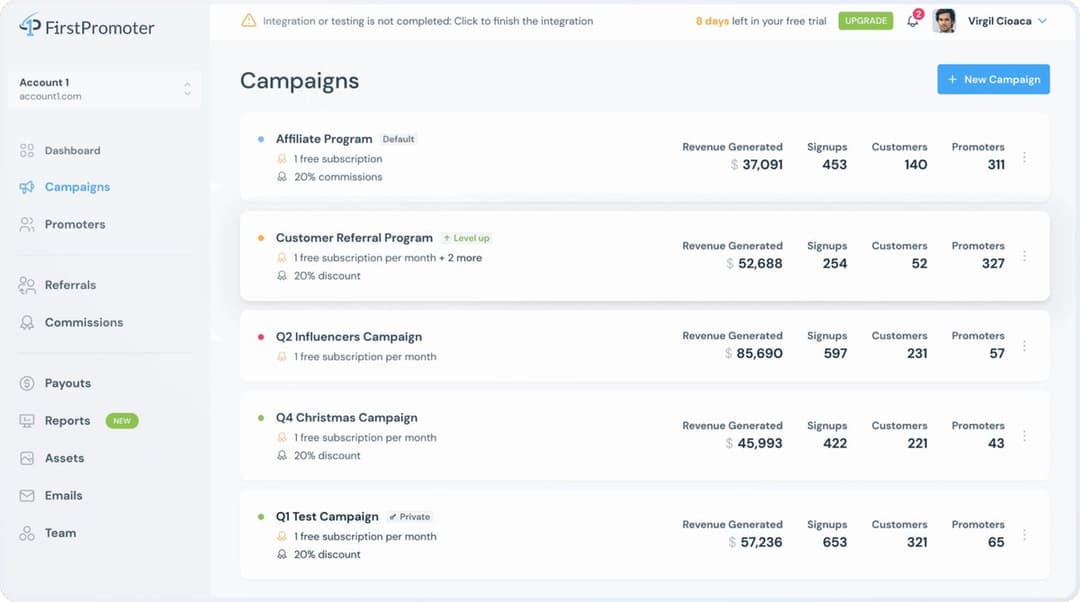
FirstPromoter is built for subscription economics the way Rewardful is, with a wider billing list, Stripe, Paddle, Chargebee, Recurly and Braintree, and reporting that goes a layer deeper: recurring revenue from affiliates, churn impact, top performers, 22 data points by day, week, month or year and inside every campaign. If your growth team lives in dashboards, this one will feel like home.
- Best for: B2B and B2C SaaS teams that want analytics alongside the program, and that bill on something other than Stripe.
- Pricing: Starter is $49 a month up to $5,000 a month in affiliate revenue, with 1,000 affiliates and 3 campaigns; Business is $99 up to $15,000 with unlimited affiliates and campaigns and a custom dashboard domain; Enterprise starts at $149. There’s a 14-day trial with no card, and no percentage fee is listed anywhere; the plans are tiered by affiliate revenue only.
- Standout features: recurring and lifetime commissions with refunds reversed on their own; coupon codes created and synced in Stripe automatically; a custom dashboard domain and custom email domain from Business, with full white-labeling on Enterprise; one-click PayPal payouts from Business; multi-tier commissions up to three levels.
- Keep in mind: the tier is set by the revenue your affiliates generate, so your bill steps up as the program succeeds. Tax-form collection is a switch you turn on rather than the default. Payouts run from your own Stripe balance on every plan, by PayPal from Business up, or as a CSV for Wise and bank transfer, so check which of those your affiliates’ countries support. The managed option, where FirstPromoter pays everyone and handles the forms, is Enterprise only and SaaS only, with approval required.
- Bottom line: the analytics-first choice for subscription businesses, and the one to pick if your billing platform isn’t Stripe.
One thing I noticed lining those three up: Rewardful lists a 0% transaction fee and FirstPromoter lists no fee at all, and both still leave the payout run with you, which is why the cost table further down compares subscription plus whoever pays, not subscription alone.
4. Trackdesk
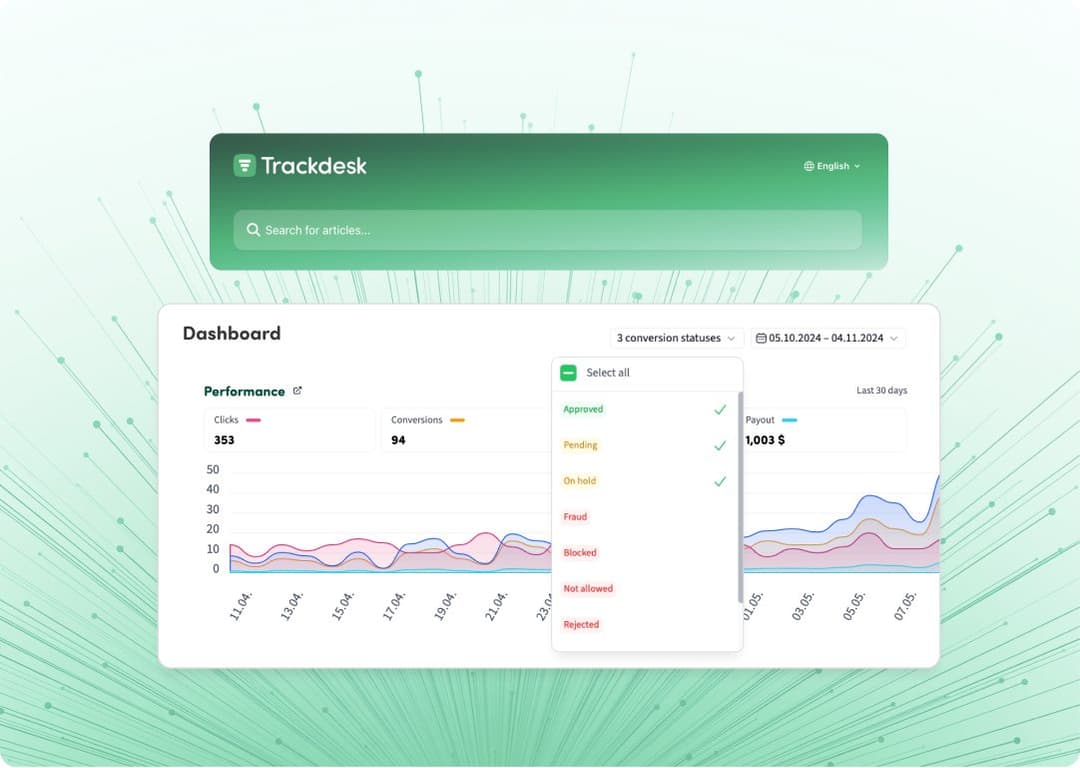
Trackdesk is the tracking engineer’s pick. It does server-to-server postbacks with a click ID, matches click IDs for Google, Meta and TikTok, tracks coupons and recurring commissions, and leaves affiliates and conversions uncapped on every plan, with a monthly affiliate-revenue ceiling per plan instead. It also runs multi-advertiser networks, which tells you who it’s built to satisfy.
- Best for: programs with real traffic volume, agencies, and anyone running a network rather than a single brand’s program.
- Pricing: Launch is $299 a month up to $50,000 a month in affiliate revenue, Scale is $599 up to $150,000, and Enterprise starts at $899 on annual billing up to $250,000, with an assisted 14-day trial and no transaction fees.
- Standout features: cookieless S2S tracking that shrugs off ad blockers; click-ID matching so your paid campaigns and your affiliates stop fighting over credit; payouts through PayPal, Wise, bank transfer or crypto, or automated through Tipalti; an affiliate marketplace for recruiting from Scale up on annual plans; 900+ integrations. Fraud protection, white-label branding, full API access and the MCP automation start on Scale too.
- Keep in mind: the entry price is $299 a month on the live page as I write this, which is a very different conversation from the sub-$50 tools above – and it only makes sense once your volume is paying for the tracking depth. Tax forms aren’t mentioned anywhere on its pricing or payout pages, so plan to collect them yourself or through whichever payout provider you connect, and Tipalti is its own account with its own fees.
- Bottom line: when tracking depth is the thing keeping you up at night and your traffic justifies $299, this is where I’d look first.
5. Post Affiliate Pro
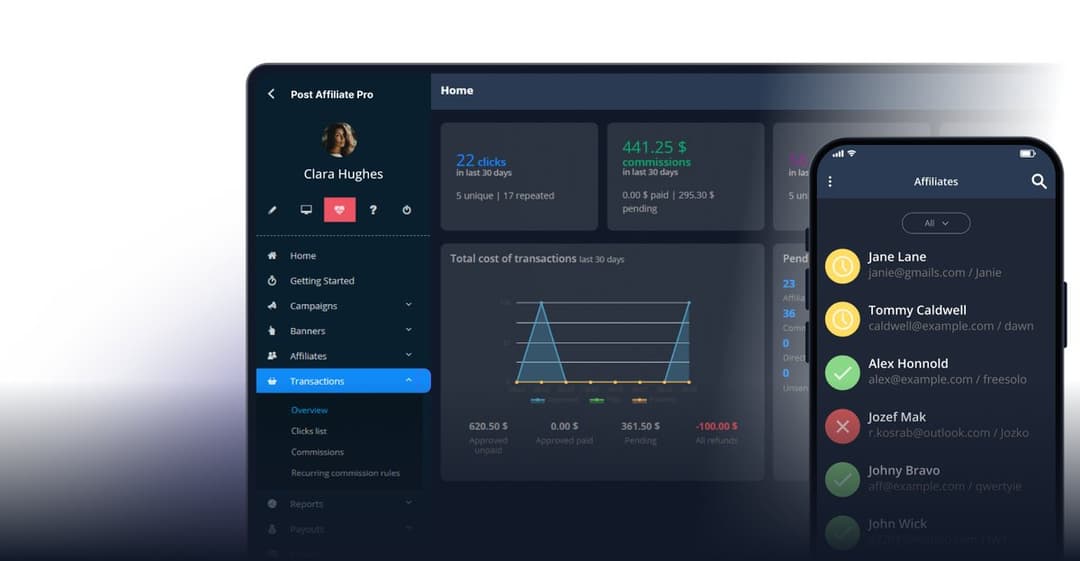
Post Affiliate Pro has been around longer than most of this category and it shows in both directions: an enormous feature set, from cookie, pixel, IP and server-to-server tracking to per-product rates, coupons, banners of every kind and 125+ plugins, and an interface that asks you to learn it.
- Best for: teams that want every tracking method and a deeply configurable program, and that are fine running payouts from export files.
- Pricing: Starter is $89 a month with one campaign and 10,000 tracking requests a month, Pro is $139, Ultimate is $269, and Network is $649, with a 30-day free trial and unlimited affiliates on every tier.
- Standout features: S2S postback tracking with an IP fallback for when cookies are blocked; recurring and lifetime commissions; multi-currency tracking as a $19 add-on on the lower tier; multilingual affiliate interfaces; a merchant signup page for running a network.
- Keep in mind: it doesn’t pay your affiliates. You mark them paid and download a mass-payment file for PayPal or your bank, and nothing on its pricing or feature pages covers tax forms, so the W-9s and 1099s are yours too. The add-ons are a la carte, which cuts both ways: a team that only wants the audit log pays $17 a month for it instead of jumping a tier, and a team that wants five add-ons should total them before comparing plans.
- Bottom line: a power tool for a team that wants control over everything and already has a finance process for payouts.
6. Refersion
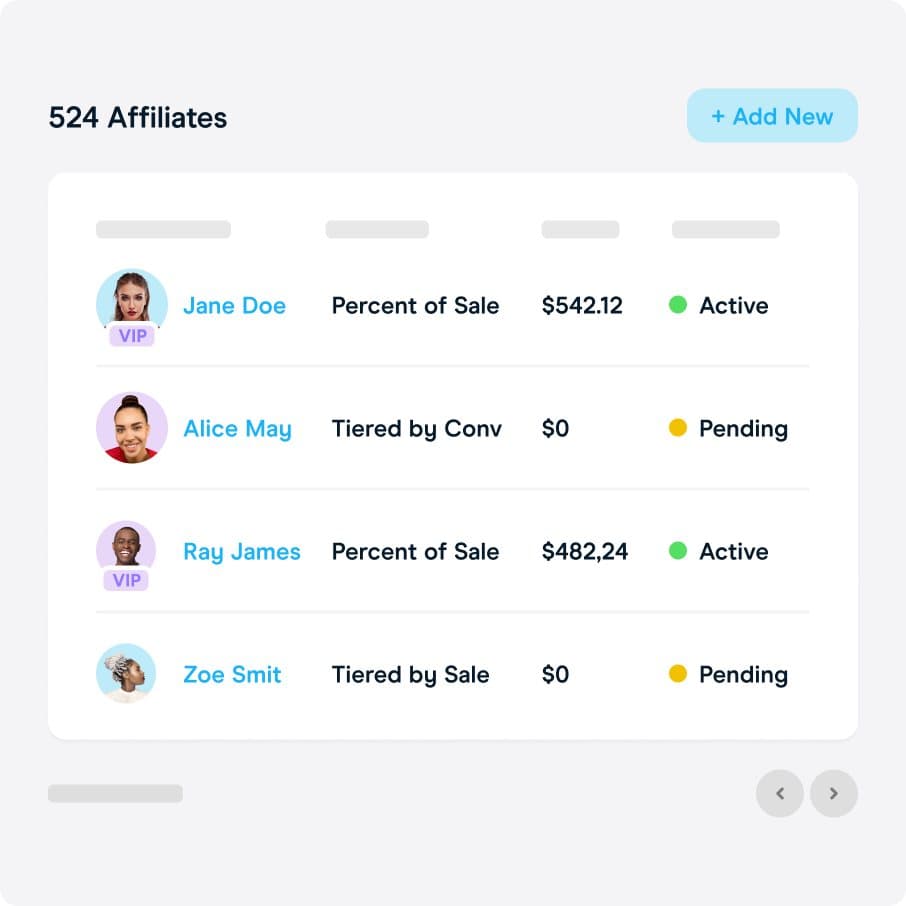
Refersion is where I’d start if you sell physical products on Shopify. It tracks at the SKU level, pays different rates per product and per customer type, and comes with a marketplace where affiliates can find your offer, which for a DTC brand is half the battle.
- Best for: Shopify, BigCommerce, WooCommerce and Magento stores that want product-level commissions and an influencer-friendly workflow.
- Pricing: Launch is $39 a month plus 3% of affiliate-driven sales, Growth is $199 plus 2% of affiliate-driven sales, and Scale is by quote for brands past $1 million in annual GMV. A free marketplace listing is available separately.
- Standout features: a first-party tracking domain; unlimited affiliates, clicks and conversions from the Launch tier; one-click payouts including PayPal; a post-purchase widget that invites customers to become affiliates; advanced tracking by product and by customer email on Growth.
- Keep in mind: the percentage of sales is the number to watch, so run the math at your volume; the crossover between Launch and Growth is in the cost table below, and it’s earlier than you’d guess. Payouts run through Refersion’s own Unified Payments, with PayPal, Venmo, Zelle, ACH and Shopify gift cards depending on the affiliate, and Refersion says it helps generate the 1099s for eligible US affiliates; Trolley is a Growth-only extra, not the rail.
- Bottom line: the ecommerce specialist on this list, priced in a way that rewards you for reading the pricing page twice.
Something the list shows that no single pricing page says: every tool that publishes its payout rails names PayPal, four of the nine bundle a recruiting marketplace, Trackdesk, Refersion, PartnerStack and Impact.com, and three run a 30-day trial, Post Affiliate Pro, LeadDyno and Impact.com’s Starter tier. If recruiting is your bottleneck rather than tracking, that marketplace column matters more than the price column.
7. LeadDyno
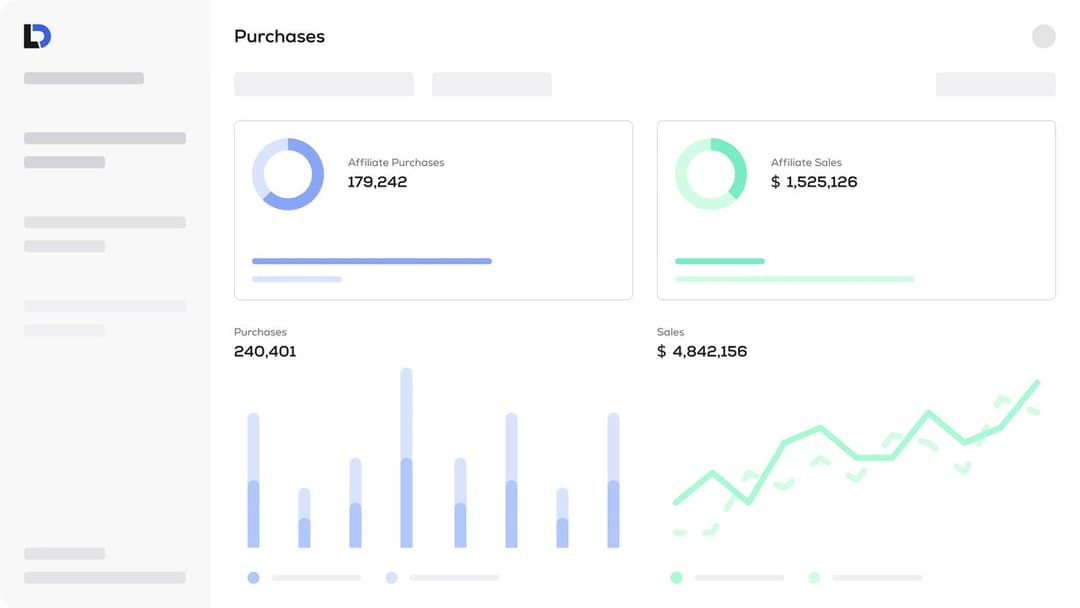
LeadDyno earns its place with two things at a flat price and no percentage: PayPal Payouts (the old MassPay) that pay every affiliate in a few clicks, and W-9 and W-8BEN collection with an export of forms and commission totals for 1099 prep. Its 25+ no-code integrations reach platforms the others skip, Shopify, WooCommerce, BigCommerce, Stripe, Recharge, HubSpot, Klaviyo, Skool and Patreon among them, which makes it a natural fit for creators and small stores.
- Best for: small stores, course and community businesses, and creators whose platform isn’t on anyone else’s integration list.
- Pricing: Lite is $49 a month, Essential is $129, Advanced is $349, and Unlimited is $749, with a 30-day free trial and unlimited clicks and conversions on every plan. Tiers step up with active affiliates, 50 on Lite, 150 on Essential and 500 on Advanced, and with features.
- Standout features: bulk PayPal payouts in a few clicks; tax-form upload inside the affiliate dashboard; a custom affiliate dashboard domain from Essential; a multi-level structure from Essential if you want one; that integration list.
- Keep in mind: the automated payout rail is PayPal only, reporting is light on segmentation, and the interface feels its age. It also collects tax forms rather than filing them, so the 1099s are still yours to send.
- Bottom line: a sensible first tool for a small program on an unusual platform that wants payouts handled without an enterprise price.
8. PartnerStack
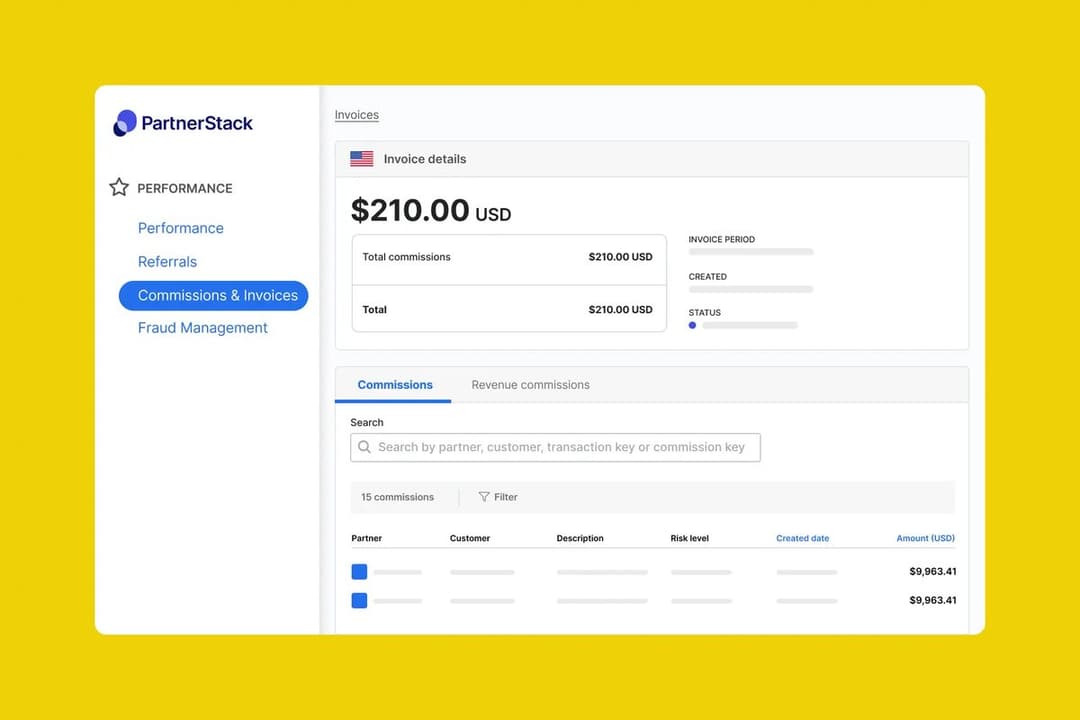
PartnerStack is less an affiliate tracker than a partner ecosystem: affiliate, referral and reseller motions in one place, two-way Salesforce and HubSpot attribution, and a network of partners who already use it to find B2B software to promote. If you’re a SaaS past seven figures with a partnerships hire, it’s on your shortlist whether I put it here or not.
- Best for: mid-market and enterprise B2B SaaS running several partner types at once, with recruiting as a priority.
- Pricing: quote only. The live page lists Launch, Growth and Enterprise plans and a demo button, and no numbers. Ask on the call whether any fee applies to partner payouts on top of the subscription, because the public page doesn’t say.
- Standout features: a built-in partner marketplace where partners come to you; attribution from click through to closed revenue, synced two-way with your CRM, so you can pay on what a referral is actually worth; one consolidated payment that PartnerStack splits out to partners by PayPal, Stripe or direct deposit; W-8 and W-9 collection for partners who withdraw by direct deposit, with 1099-Ks issued where they apply, while Stripe and PayPal withdrawals rely on those providers’ own forms; lead and deal registration for reseller and referral partners.
- Keep in mind: there’s no self-serve trial, so you’re buying through a sales process, and the price reflects a mid-market product. Partners trigger their own withdrawals, which some programs find slower than a scheduled run.
- Bottom line: the right answer when “affiliates” is one of three partner types you manage, and the wrong one for a solo founder’s first program.
9. Impact.com
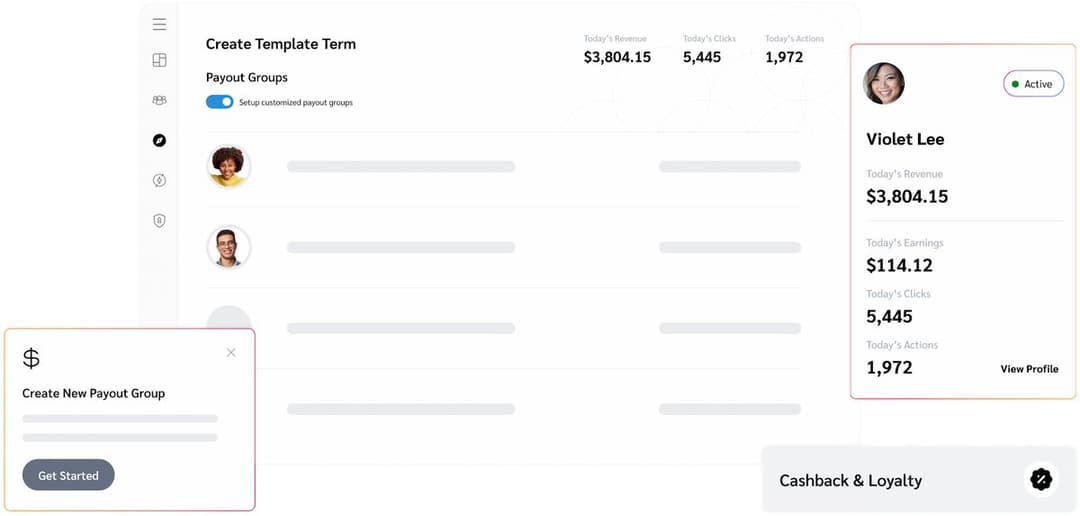
Impact.com is the category’s enterprise platform: discovery and recruiting from a marketplace of 250,000+ partners, automated contracting, cookieless cross-device attribution, fraud protection, and partner payouts in 70+ currencies. It’s also the one tool here that honestly describes itself as a partnerships platform rather than affiliate software, and that’s fair.
- Best for: brands running affiliate, creator, referral and retail media partnerships together, with the budget and the team to run them.
- Pricing: Starter is self-serve at $30 a month plus 2.5% of revenue, with basic tracking, a 30-day trial, and one catch: it’s only offered to stores on Shopify, WooCommerce, BigCommerce, Adobe Commerce, Squarespace, Ecwid, Shoplazza, nopCommerce and Zoho Commerce, and the page doesn’t define which revenue the 2.5% applies to. Essentials is $500 a month on a 12-month contract and includes up to $2,500 a month in partner payouts, with a minimum of $2,500 a month in processed payouts and onboarding billed at $250 an hour. Pro is $2,500 a month with up to $14,300 a month in payouts included, and Enterprise is custom.
- Standout features: a vetted marketplace that spans affiliates, publishers and creators, so recruiting is a search rather than a cold email; contracts that apply themselves to every partner who joins; cookieless attribution across devices, with multi-touch on Enterprise; partner payouts in 70+ currencies on a schedule, funded in your currency and paid in theirs.
- Keep in mind: Starter is a toe in the water, and the product you’re reading about starts at the $500 tier, which has a payout minimum attached. Run the Essentials math before you flinch at it: $500 includes $2,500 of payouts, so at the minimum you’re paying for the platform and the payout run together, and the number only looks high next to a tool that leaves the payout run to you.
- Bottom line: the platform for a team that runs partnerships as a department, with a budget line to match.
What $5,000 a month in commissions actually costs
The math: this is the part I enjoy, because pricing pages are written to be compared on the base price and the base price is rarely the bill. Take a program paying $5,000 a month in commissions at a 20% rate, so $25,000 a month in affiliate-driven revenue, billed monthly, and run it through each tool’s live pricing page:
| Tool | Plan at this volume | Monthly cost | Who pays the affiliates |
|---|---|---|---|
| Rekomi | Growth $49 + 3% of $5,000 | $199 | Rekomi, tax forms included |
| Rewardful | Enterprise from $149 (Growth caps at $15,000 attributed revenue) | $149+ | You, unless you add Managed Payouts |
| FirstPromoter | Enterprise from $149 (Business caps at $15,000) | $149+ | You, or managed on Enterprise |
| Trackdesk | Launch, under its $50,000/mo revenue limit | $299 | You, through PayPal, Wise or Tipalti |
| Post Affiliate Pro | Starter or Pro depending on tracking requests | $89 to $139 | You, from an export file |
| Refersion | Growth $199 + 2% of $25,000 | $699 | Refersion, via one-click payouts |
| LeadDyno | Lite to Advanced by active-affiliate count | $49 to $349 | You, via PayPal Payouts |
| PartnerStack | Quote | Quote | PartnerStack |
| Impact.com | Starter $30 + 2.5% of $25,000 | $655 | Impact, global |
caption: Monthly-billed figures from each live pricing page on November 4, 2026. Annual billing lowers several of them. Impact’s row assumes the 2.5% applies to affiliate-driven revenue, which its page doesn’t define.
Two things fall out of that table, and both are the kind of finding I love pulling out of a pricing page. First, the 0% tools and the 3% tools land within $50 of each other at this volume, which means the real difference is who runs the payout, not the price! Second, Refersion’s Launch plan, the one with the lowest number on the page at $39, would cost $789 here ($39 plus 3% of $25,000), more than its own Growth plan at $699. The crossover sits around $16,000 a month in affiliate-driven sales, and nothing on the page tells you that; only the math does.
So, run your own numbers before you pick. The three inputs are your monthly commissions, your average commission rate (which gives you attributed revenue), and whether you want to be the one pressing pay.
How do you manage affiliates once the program is live?
You manage affiliates on a monthly loop: approve applications against a short rule set, activate the new ones in their first week, review commissions and refunds before the hold ends, run payouts on the same day each month, and send one useful update to the whole program. Good affiliate program management software should do the first, third and fourth of those for you; the second and fifth are relationships, and no software replaces them.
Here’s how I run it, and the parts I let the tool handle:
- Approvals, which the software does with a human veto. Set a rule for auto-approval (a real website or channel, a country you pay to, no obvious duplicate), and look at the ones that don’t clear it once a week. An unapproved affiliate who waited eleven days usually doesn’t promote you.
- Activation, which is yours. The first week decides whether an affiliate ever sends a sale. A short welcome with their link, their code, two creative assets and the one thing that converts best for you does more than any dashboard feature. Tools with a custom sending domain make that email look like it came from you, which it should.
- Commission review, which the software does. Flag anything odd before the hold window closes: a sudden spike from one affiliate, orders that refund at twice your normal rate, clicks that score as proxies or data-center traffic. The refund mirror does the boring part; you make the one call a month that needs judgment.
- Payouts, which the software does. Pick a payout day and never move it – the consistency is the feature. If your tool pays affiliates for you, this step is literally a button and a receipt. If it doesn’t, block the morning: export, pay, record, and keep the tax forms current before year end so January isn’t a scramble.
- The monthly note, which is yours. One email, once a month, with what’s working, what’s new, and a number (your best affiliate earned $X last month). This is the single highest-leverage habit I’ve seen in any program, and it’s free!
How to choose affiliate management software for your setup
Here’s the honest routing by setup:
- A SaaS billing on Stripe, under $15,000 a month in affiliate revenue, with someone happy to run payouts: Rewardful or FirstPromoter. Both are simple and accurate, and neither lists a percentage of your commissions. I compared the SaaS-only field in more depth in the best affiliate software for SaaS.
- A brand that wants payouts and tax forms off its plate, on Stripe, Shopify, Paddle, Chargebee, WooCommerce or most other platforms: Rekomi. The 3% is the price of never touching a W-9.
- A Shopify or ecommerce store with a catalog: Refersion for SKU-level commissions and the marketplace, LeadDyno if your platform is on its list and nobody else’s.
- A program with heavy traffic or a network of advertisers: Trackdesk for the tracking stack, Post Affiliate Pro if you want maximum configurability and have a finance process for payouts.
- A mid-market or enterprise team running several partner types: PartnerStack for B2B SaaS, Impact.com for multi-channel partnerships with creators and publishers in the mix.
- Your first program ever, with no budget approved yet: start with the trial on whichever of Rekomi, Rewardful, FirstPromoter or LeadDyno matches your billing platform, run the monthly loop above once with a test affiliate and a test purchase, and only then compare prices. Two weeks of real use beats any comparison table, including this one.
Frequently asked questions
What is an affiliate management system, and is it different from tracking software?
Yes, they’re different, although the terms get mixed. Tracking software records which affiliate sent a click and ties the sale back to them. An affiliate management system does that and also runs the program: approvals, commission rules, refund holds, payouts, tax forms and reporting. Every tool on this list tracks; fewer of them manage the whole loop.
How much does affiliate program management software cost?
Entry prices on the live pages run from $29 to $49 a month for Rekomi, Rewardful, FirstPromoter, Refersion and LeadDyno, $89 for Post Affiliate Pro and $299 for Trackdesk; PartnerStack is quote-only, and Impact.com publishes $500 and $2,500 tiers above its $30 Starter. The base price rarely equals the bill, because some tools add a percentage of payouts or sales and others leave you to pay affiliates yourself.
Can affiliate management software pay my affiliates and file their tax forms?
Yes, some of it can. Rekomi pays affiliates directly as the payer of record and files the 1099-NECs. PartnerStack pays partners and collects forms on its direct-deposit path, and Impact.com pays in 70+ currencies but keeps its tax process off the public pages. Rewardful (an add-on) and FirstPromoter (Enterprise) offer managed payouts; LeadDyno, Post Affiliate Pro and Trackdesk leave the filing with you.
What does an affiliate manager do that software can’t?
An affiliate manager recruits the right partners, gets new affiliates to their first sale, negotiates the rates and bonuses that keep top performers engaged, and writes the monthly note that keeps the program alive. Software should take the approvals, commission math, fraud checks, payouts and tax paperwork, which is most of the hours, so the manager’s time goes to the relationships.
Do I need affiliate management software for a small program?
Yes, as soon as you have more than a handful of affiliates or a single international one. Below that, a spreadsheet and manual PayPal transfers work for a month or two. Past it, the refund reversals, the tax forms and the payout schedule are exactly the things people get wrong by hand, and the entry plans on this list cost less than one mistake.
Does affiliate management software work for ecommerce as well as SaaS?
Yes, but the fit varies by tool. Refersion and LeadDyno are built around stores and product catalogs, Rewardful and FirstPromoter around subscription billing, and Rekomi, Trackdesk, Post Affiliate Pro and Impact.com cover both through native store and billing integrations. Check that your checkout platform is a native integration rather than a workaround before you trial anything.
Which affiliate management software has a free trial?
Rekomi, Rewardful, FirstPromoter and Trackdesk run 14-day trials, Post Affiliate Pro and LeadDyno run 30-day trials, and Impact.com’s Starter tier has a 30-day trial on its supported ecommerce platforms. Refersion’s page doesn’t name a trial length, and PartnerStack sells through a demo rather than a trial. None of the nine has a free plan for brands as I write this.
The three-question test before you pick
Open whatever you run today (a tool, a spreadsheet, a Notion page) and answer three questions in writing: who pays the affiliates, who files their 1099s, and what happens to a commission when a refund lands. If any answer is “me, manually” and you’d rather it weren’t, you’ve just written your shortlist. If every answer is “the software”, you’re in better shape than most programs I’ve seen, and you can spend the rest of the afternoon on the monthly note instead.
If you’d like the software to be the answer to all three, start a 14-day free trial of Rekomi, connect your billing platform, and run one test purchase through to a payout. You’ll see the W-9 get collected and the refund reverse without you touching either.
Start a free trial

