

An affiliate agreement is the contract between your company and each affiliate, and it has to answer 13 things, starting with what you pay, when you pay it and when you take it back. Plenty of programs get the commission clause right and skip the refund clause, which is the one that costs money. I like this document more than I probably should, because every clause in it is a dispute you get to settle in advance, while everyone still likes each other.
Below is each clause with sample wording you can copy, in the order the finished document runs, plus the one piece of math that decides your payout schedule. I’m not a lawyer and this isn’t legal advice, so treat the wording as a head start and have counsel read your final version before anyone accepts it.
The four clauses that settle most disputes
- The commission clause states the rate, how long it applies and what counts as a qualified referral, all in one paragraph, so “20%” can’t mean the first payment to you and lifetime to them.
- The attribution clause names the window in days and makes your tracking records the final word, because someone’s numbers have to win.
- The refund clause reverses commission on refunds and chargebacks inside a set number of days, and it only works if the payout date falls after your refund period ends.
- The conduct clause lists brand bidding, coupon-site posting, self-referral and spam by name, with termination and forfeiture as the consequence.
What is an affiliate agreement?
An affiliate agreement is a contract that sets the terms an affiliate promotes your product under: what they earn, how referrals are tracked, when they’re paid and what they aren’t allowed to do. You’ll also see it called an affiliate marketing agreement, an affiliate contract or affiliate terms and conditions, and for a program with public sign-up those are all the same document.
It’s almost always digital: the affiliate ticks a box on the application form (lawyers call that a clickwrap agreement), and that acceptance, stored with a timestamp and the version they accepted, generally does the job of a signature as long as the terms were clearly shown before the click. A PDF with two signature lines is for the handful of big partners who negotiate their own rate.
Also, every clause is a promise some system has to keep: a 60-day window on paper needs a 60-day window in the tracking, and a clawback clause needs software that knows a refund happened. So, don’t promise anything in the agreement that your tooling can’t enforce without you.
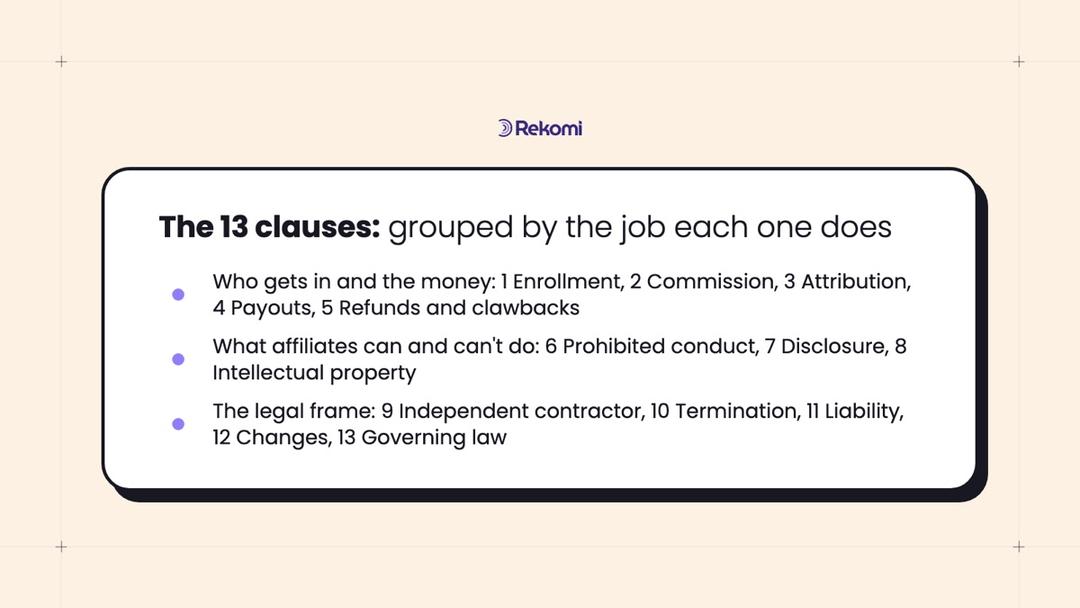
Clauses 1 to 5: who gets in, and how the money works
These five decide what an affiliate earns, so they’re the ones affiliates read. I’d put a real number in every blank, since “a competitive commission” is where arguments start.
1. Enrollment
Enrollment says when the relationship begins and that you can decline anyone. It sounds like a formality until the first coupon site applies and you’d like to say no without a debate.
Participation in the Program begins when the Company approves the Affiliate’s application and the Affiliate accepts this Agreement. The Company may approve or decline any application at its discretion.
2. Commission
The commission clause needs three facts in it: the rate, how long it applies and what a qualified referral is. The third is the one people forget - “a new customer who completes a paid purchase” keeps free trials and existing customers out of the count. If you’re still choosing the number, my guide to affiliate commission rates has the ranges by business model.
The Company will pay the Affiliate a commission of [20]% of the revenue from each Qualified Referral. Commission applies to [every payment made by the referred customer during their first 12 months as a customer]. A Qualified Referral is a new customer who signs up through the Affiliate’s tracking link or code and completes a paid purchase.
3. Tracking and attribution
This clause names the window and, more importantly, whose records decide. Two affiliates will eventually claim the same customer, and the agreement should already say that your tracking system settles it. Whether the first click or the last one wins belongs here too, and I compare the two in last-click vs first-click attribution.
Referrals are tracked through the unique link and/or code assigned to the Affiliate. A referral is attributed to the Affiliate when the customer arrives through the Affiliate’s link or uses the Affiliate’s code within [60] days of first clicking the link (the “Attribution Window”). The Company’s tracking records are the system of record for attribution and commission calculations.
4. Payouts
Payouts cover the schedule, the minimum balance and what the affiliate owes you before money can move, which is accurate payout details and a tax form. A $50 minimum is common, and it saves you from sending forty $3 payments a month!
Approved commission is paid [monthly, within 15 days after the end of each calendar month]. Payouts are made once the Affiliate’s approved balance reaches [$50]; balances below the minimum roll over to the next payout period. The Affiliate is responsible for providing accurate payout details and any tax information the Company reasonably requests before payment can be made.
5. Refunds and clawbacks
This is the clause many template documents skip and accountants care about most. It says a refunded sale earns no commission, and it says how you get the money back if you’d already paid it.
If a referred purchase is refunded, charged back, or cancelled within [30] days of the transaction, the corresponding commission is reversed. Reversed commission that has already been paid is deducted from the Affiliate’s future payouts automatically; where that is not possible, the Affiliate will repay the amount on request.
Here’s how it works: say your refund policy is 30 days and you pay affiliates on the 15th for the previous month’s sales. A sale on June 1 gets paid on day 44, safely past the refund period. A sale on June 28 gets paid on day 17, and that customer can still ask for their money back for another 13 days. In June, every sale from the 16th onward is in the same position, so about half of a month’s commissions go out while they can still be refunded.
Now put volume on it: with 500 affiliate sales a month, a $20 commission and a 4% refund rate (4% is a guess, and your billing dashboard has the real one), that’s 20 refunds and $400 of commission to reverse every month, and some of it has already left your account (chasing a $20 repayment by email is nobody’s favorite afternoon).
The fix: hold each commission for 30 days before it becomes payable, which is one setting. Then every commission is past its refund period when it’s paid, and the clawback clause becomes a rule that almost never has to recover anything!
I love that about this clause: one line of scheduling does the work of a whole collections process.
Clauses 6 to 8: what affiliates can and can’t do
The conduct clauses are super short to write and they do most of the protecting. What I’ve noticed is that vague ones (“no unethical promotion”) get ignored and specific ones get followed, so name the behavior.
6. Prohibited conduct
Four behaviors cause most of the trouble, and each one deserves its own line. Brand bidding is the expensive one, because you end up paying commission on customers who were already typing your name into Google (the full policy is in my post on brand bidding).
The Affiliate agrees NOT to engage in any of the following: (a) bidding on the Company’s brand name, trademarks, or misspellings of them in paid search advertising; (b) posting assigned coupon or discount codes to coupon aggregator sites; (c) self-referral, meaning using their own affiliate link or code to purchase for themselves or for any business they control; (d) promoting through unsolicited bulk email, misleading claims, cookie stuffing, or any technique that fabricates referrals. Violation of this section is grounds for immediate termination and forfeiture of unpaid commission connected to the violation.
7. Disclosure compliance
Disclosure protects you as much as the affiliate. In the US, the FTC’s Endorsement Guides say a paid relationship has to be disclosed clearly, and they expect the brand to tell its affiliates so and to keep an eye on them. Writing it into the agreement is the “tell them” half.
The Affiliate agrees to clearly disclose their material connection to the Company wherever they promote the Program, in accordance with the FTC’s endorsement guidelines and any equivalent rules that apply in the Affiliate’s jurisdiction.
8. Intellectual property
The IP clause lets affiliates use your logo and screenshots, and takes that permission back when the relationship ends. Without it, a former affiliate’s page with your logo on it is technically nobody’s problem.
The Company grants the Affiliate a limited, revocable, non-exclusive license to use the Company’s name, logo, and approved marketing materials solely to promote the Program. The license ends when this Agreement ends.
Where paper runs out: none of these three enforces itself. A no-self-referral line with nothing checking for it is a rule nobody tests, which is why the conduct section and your fraud screening are really one job done in two places.
Clauses 9 to 13: the legal frame around it
The last five are the ones your lawyer will have opinions on, and they’re the ones I’d change least. Most programs never need them - but the one time you do, they decide the whole thing.
9. Relationship of the parties
This clause says the affiliate is an independent contractor and not an employee, an agent or a partner. The label alone doesn’t settle that, the way you actually work together does, so keep affiliates free to promote how and when they like. It’s also why US tax paperwork works the way it does: the payer collects a W-9 and files a 1099-NEC once an affiliate’s payments in a year reach the IRS threshold, which is $2,000 for payments made in 2026 (it was $600 before, and it adjusts for inflation from 2027).
The Affiliate is an independent contractor. Nothing in this Agreement creates an employment, agency, partnership, or joint venture relationship. The Affiliate has no authority to make commitments on the Company’s behalf.
10. Termination
Termination gives both sides a clean way out, plus an immediate one for fraud. The sentence affiliates look for is the last one, which says commission already earned still gets paid.
Either party may terminate this Agreement with [30] days’ written notice. The Company may terminate immediately for violation of Section 6 or for fraud. Upon termination, approved commission earned before the effective date (and not subject to reversal) will be paid on the normal schedule.
11. Limitation of liability
This one caps what you can owe an affiliate at the commission that’s unpaid when a claim comes up. It’s standard wording, and the cap is what keeps a $200 commission dispute a $200 dispute.
The Company’s total liability to the Affiliate under this Agreement is limited to the commission owed and unpaid at the time a claim arises. Neither party is liable for indirect, incidental, or consequential damages.
12. Changes to the program
You’ll change your rate or your window at some point, so the agreement should say how. The fair version is forward-only with notice, and I think it’s also the smart one, since an affiliate who believes last month’s earnings are safe keeps promoting.
The Company may update commission rates, the Attribution Window, or Program rules prospectively with reasonable notice to the Affiliate. Changes do not apply retroactively to commission already earned.
13. Governing law
Governing law names the state or country whose rules apply if it ever ends up in front of a judge. Most companies pick the place they’re registered or based in.
This Agreement is governed by the laws of the State of [State], without regard to its conflict-of-law rules.
How do you make the template your own?
Three edits turn the sample wording into your agreement, and I’d make them in this order. Start with the commission duration, because “20%” means very different money on a first payment than on a customer’s lifetime. Then match the clawback days to your real refund policy. Last, check the prohibited list against your channels (if you want coupon sites in your program, delete that line instead of leaving a rule you won’t enforce).
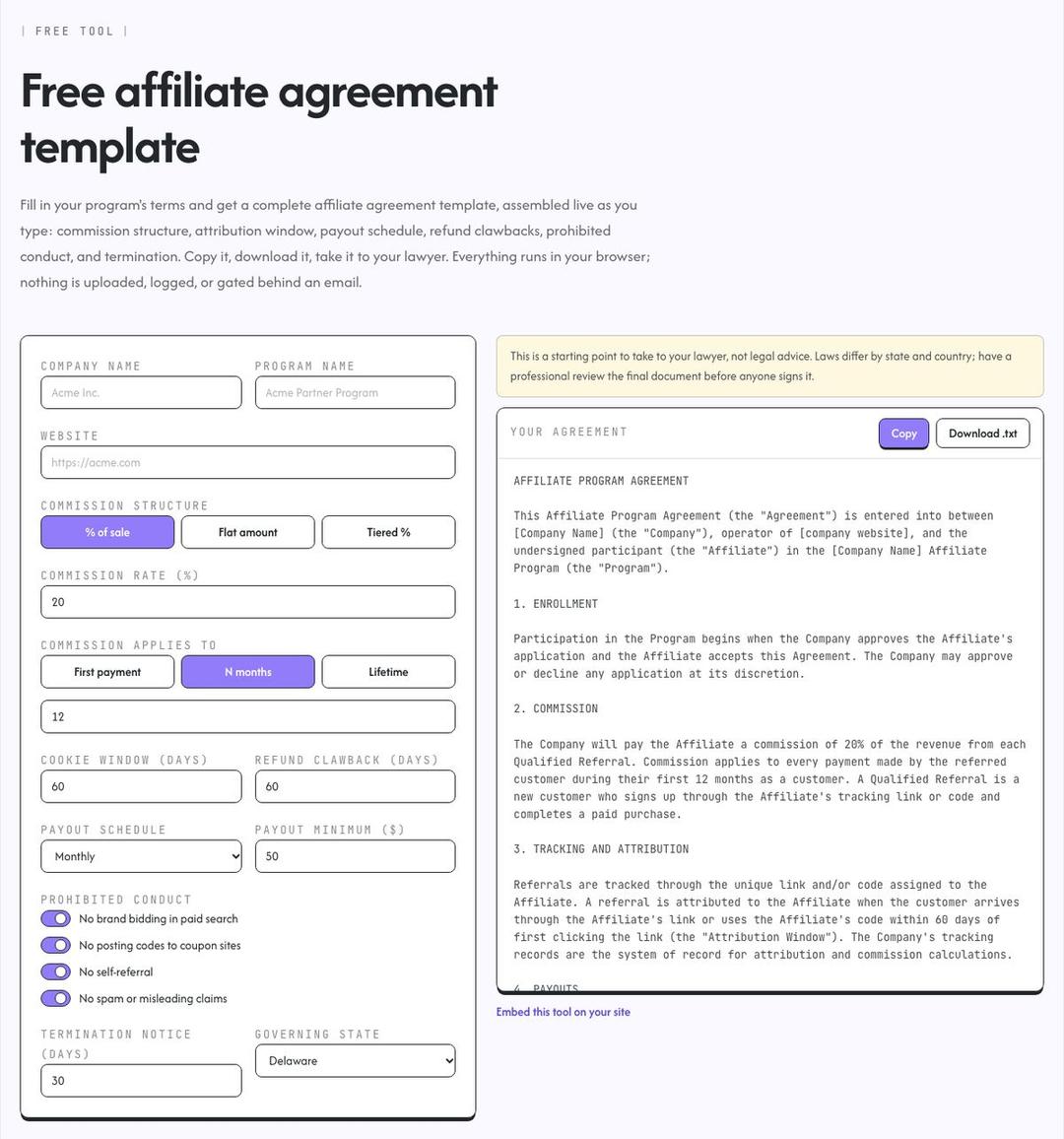
If you’d rather not assemble it by hand, Rekomi’s free affiliate agreement template builder takes your company name, rate, window, payout schedule and clawback days, and writes all 13 clauses as you type. There’s no signup, nothing you enter leaves your browser, and you can copy the result or download it as a text file for your lawyer.
A creator you pay a flat fee and a partner who passes you leads need different paper, so there’s an influencer agreement template and a referral agreement template too.
Frequently asked questions
Is an affiliate agreement legally binding?
Yes, generally. Once the affiliate accepts it and you approve them, it can be enforced like other contracts, provided the terms were clearly presented and are lawful where you both operate. A checkbox acceptance with a stored timestamp is normally enough, as long as you also keep the version of the terms they accepted.
Do affiliates need to sign the agreement by hand?
No. Most programs use a clickwrap acceptance, where the affiliate ticks “I agree to the program terms” on the application form. Keep a record of the date, the account and the version of the terms they accepted. A signed PDF is only worth the effort for individually negotiated deals with large partners.
Is an affiliate an employee or an independent contractor?
An affiliate is an independent contractor in nearly every program, and the agreement should say so directly. They choose how and when to promote, they use their own channels and they’re paid on results. That’s also why US affiliates give you a W-9 and, once they pass the IRS threshold, receive a 1099-NEC instead of a payslip.
What is the difference between an affiliate agreement and affiliate terms and conditions?
There’s no practical difference for a public program. “Affiliate terms and conditions” usually means the standard terms every applicant accepts on sign-up, and “affiliate agreement” or “affiliate contract” is the same content, sometimes signed individually. A negotiated partner might get both: the standard terms plus a short schedule with their own rate.
Can you change the agreement after affiliates have joined?
Yes, as long as the agreement says how and the change only applies going forward. Give written notice, usually 30 days, and never reduce commission that has already been earned. Affiliates who disagree can leave under the termination clause, which is one reason that clause should always pay out approved balances.
Do you need a lawyer to write an affiliate agreement?
No, not to draft it. A good template covers the clauses most programs need, and the commercial terms are your decision anyway. You do want a lawyer to review the result once, especially the liability, governing law and tax sections, since those depend on where your company and your affiliates are based.
Write down your five numbers first
The whole agreement hangs on five numbers: the commission rate, the attribution window in days, the clawback days, the payout minimum and the termination notice. Write those five down before you open any template, and check that the clawback days are at least as long as your refund policy. That’s the hard part done, and it literally fits on a sticky note.
If you’d like the hold period and the automatic reversal from clause 5 running without you, Rekomi does both and pays your affiliates for you. You can see the pricing here, and it starts with a 14-day free trial.
Start a free trial

