


TL;DR. Here is how to pay affiliates with Rekomi: you do not, really, because Rekomi does it for you. Payouts run automatically through Stripe in 42 countries (including the US), with bank deposits covering 60 more and PayPal 30 more, 130+ countries in total. Stripe collects each affiliate’s W-9 or W-8 at onboarding and issues their 1099-NECs, so you never chase forms or file 1099s yourself.
You pay a low monthly base plus a small take that only applies when affiliates actually earn. The whole money-and-paperwork side of an affiliate program becomes something you barely touch.

Paying affiliates is normally two separate headaches: moving the money, and handling the tax paperwork. Rekomi is built to take both off your plate. US businesses file billions of tax information returns a year, and the IRS received nearly 4.6 billion in fiscal 2024 (IRS); with Rekomi, your affiliates’ 1099-NECs are part of that flow without you lifting a finger.
This guide walks through how paying affiliates works on Rekomi, end to end, and what you no longer have to deal with yourself.
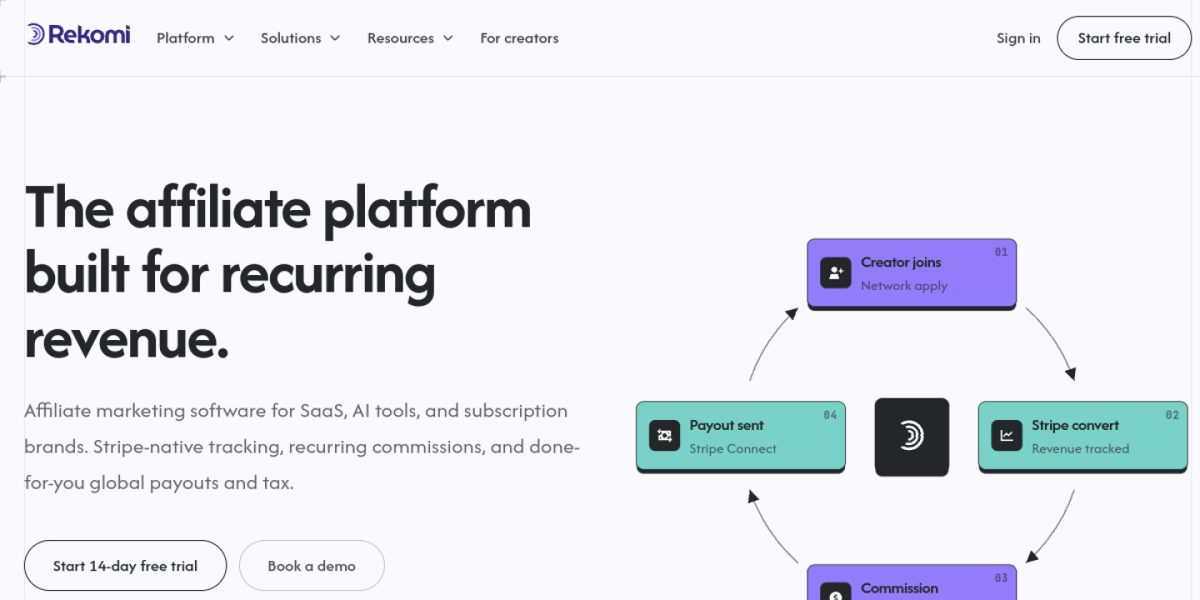
How Rekomi pays your affiliates
Once an affiliate is approved, Rekomi handles the payouts automatically. The rail is chosen by the affiliate’s country, not picked by hand:
- Stripe for 42 supported countries, including all of the US, most of Europe, Canada, Australia, the UK, Japan, and Singapore.
- PayPal for many other countries. Affiliates there add a PayPal email and are paid the same way.
- Manual for the few countries neither reaches.
Each affiliate connects one payout account, and all of their earnings across your campaigns consolidate into a single payment per cycle. You set the schedule and the rules; Rekomi runs the transfers.
How a commission becomes a payout
The timing is built to protect your margin:
- Earned, then held. A commission is recorded on a referred sale, then held through a grace period (often about a month) so refunds can settle first.
- Cleared and consolidated. After the grace period, cleared commissions bundle into one payout per affiliate per cycle.
- Paid above a threshold. Payouts release once a balance clears your minimum (commonly around $50), keeping fees off tiny amounts.
- Clawed back if needed. If a sale is refunded or charged back, the matching commission reverses automatically.
Mass payouts: paying dozens of affiliates in one run
Once your program grows past a handful of partners, paying them one at a time stops being realistic. Mass payouts, sometimes called bulk affiliate payouts, means settling everyone you owe in a single batch: one run, one funding charge, and every affiliate paid at once. On Rekomi, that is the default way payouts work, not a premium add-on.
Here is what a payout run looks like:
- Pick who gets paid. Rekomi lists every affiliate with a cleared balance over the threshold; include them all or deselect a few.
- Confirm one total. You see the full amount, fee included, before any money moves.
- Fund it once. A single charge covers the whole run; you are not initiating dozens of separate payments.
- Transfers fan out automatically. Rekomi dispatches an individual Stripe transfer to each affiliate. You never touch them.
- Track and retry per affiliate. Every transfer carries its own status, and any that fail (a stale bank account, say) can be retried without rerunning the batch.
Compare that with making mass payments to affiliates by hand from PayPal or your bank: thirty transfers means thirty statement lines to match, thirty chances to fat-finger an amount, and no single record of what went out or why. A consolidated run gives you one charge to reconcile, one receipt for the books, and a per-affiliate audit trail showing exactly which commissions each transfer covered. Your accountant sees a batch, not a blizzard.
Mass payouts also scale with you. Pro and Enterprise carry unlimited payout volume, and the volume guides on Starter and Growth are soft targets, not walls; there are no overage fees for a big month. Whether you are paying five affiliates or five hundred, the run works the same way. See how Rekomi payouts work for the full picture.
How Rekomi handles the tax forms
This is the part that surprises people, in a good way. Because your affiliates are paid through Stripe, Stripe collects each affiliate’s tax form during onboarding and issues the 1099-NECs to your US affiliates as the payer of record. You never collect a W-9, store a sensitive tax ID, or file a 1099 at year end.
- US affiliates complete a W-9 inside Stripe’s onboarding, and Stripe issues them a 1099-NEC if they earn $600 or more from you in a year.
- International affiliates complete a W-8BEN or W-8BEN-E and generally receive no US 1099; their form documents that they are not US taxpayers.

What you no longer have to do
If you paid affiliates yourself, by your own PayPal, bank transfer, or check, all of this would land on you: collecting a W-9 from every US affiliate before paying them, tracking who crosses $600, filing each 1099-NEC by January 31, and figuring out W-8 forms and possible withholding for international affiliates. With Rekomi, that entire list is handled for you. You approve affiliates and watch the dashboard; the paperwork takes care of itself.
Setting it up: four steps
- Connect Stripe so Rekomi can see which sales each affiliate drives.
- Invite or import your affiliates, who connect their own payout account once.
- Set your commission, grace period, and threshold, then let Rekomi track and run payouts on your schedule.
- Leave the forms to Stripe, which collects W-9s and W-8s and issues the 1099-NECs.

What it costs
Rekomi is a low flat base ($29/mo, $49/mo, or $99/mo, with a custom Enterprise tier) plus a 3 percent take (2.5 percent on Enterprise) charged only on what affiliates actually earn. Done-for-you payouts and tax handling are included in that take, with no separate add-on fee, and there is a 14-day free trial. For a wider look at the category, see our guide to the best affiliate software for SaaS, and if you want the affiliate’s-eye view of this flow, point your partners to how affiliates get paid on Rekomi.
Pay affiliates without the paperwork
Rekomi runs your payouts on Stripe and lets Stripe handle the W-9s and 1099-NECs, so year-end is not your problem. Start a 14-day free trial and pay your first affiliate this week.
Start a free trialFrequently asked questions
Do I have to send my affiliates a 1099?
Not on Rekomi. Because affiliates are paid through Stripe, Stripe issues the 1099-NECs to your US affiliates who cross $600. You do not collect W-9s or file 1099s yourself.
How does Rekomi pay affiliates in other countries?
Rekomi routes each affiliate to the right rail by country: Stripe for the 42 supported countries, and PayPal for many of the rest. You do not run two systems; it is automatic.
Do I need to collect a W-9 from each affiliate?
No. Stripe gathers the W-9 (US) or W-8 (international) during the affiliate’s onboarding, so you never handle or store those forms.
When do affiliates get paid?
On the schedule you set (usually monthly), after a grace period that lets refunds settle and once each balance clears your minimum threshold. Refunds and chargebacks claw back first, then the payout goes out.
What does it cost to pay affiliates with Rekomi?
A low monthly base ($29, $49, or $99, plus custom Enterprise) and a 3 percent take (2.5 percent on Enterprise) that applies only to what affiliates earn. Payouts and tax handling are included, with a 14-day free trial.
The bottom line
Paying affiliates is moving money plus handling paperwork, and Rekomi does both. Payouts run automatically through Stripe and PayPal, Stripe collects the tax forms and issues the 1099-NECs, and you are left to focus on growing the program instead of chasing W-9s in January.
Disclaimer. This article is general information, not tax or legal advice. Tax rules vary by country and change over time, so please consult a CPA or a qualified tax professional about your own situation before making decisions.


