

Affiliate marketing vs influencer marketing comes down to what you’re buying: affiliate marketing buys a sale and pays after it happens, and influencer marketing buys a post and pays before anyone has seen it. A brand ambassador is the third option, where you’re buying an ongoing relationship. The same creator can be all three in one year, so the question I’d ask on every deal is “what am I paying for this time?”
I really enjoy this comparison, because the same 9 sales can cost you $108 or $1,000 with one line of the deal changed, and both prices can be fair. The table comes first, then one creator paid a fee and then a commission with real numbers, then the mix most deals end up as.
What to pay for: the post, the sale, or both
- A flat fee is the right deal when you want reach and content, since you’re buying the post, the audience and often the right to reuse the video, and you’d judge it by cost per thousand views.
- Commission is the right deal when you want sales, because your cost per sale is fixed at commission rate × order value before anyone posts, and a post that sells nothing literally costs nothing.
- A smaller fee plus a commission fits a creator with real reach who you want to keep selling, and it’s a deal many experienced creators ask for anyway.
What is the difference between affiliate marketing and influencer marketing?
The difference between affiliate marketing and influencer marketing is the thing on the invoice. One invoice says “9 sales at $12 each”, and the other says “one sponsored video, $1,000”. The risk, the way you measure it and how long the relationship lasts all follow from that.
| Affiliate marketing | Influencer marketing | Brand ambassador | |
|---|---|---|---|
| You pay for | Sales (or leads) | A post, video or mention | A relationship over months |
| You pay | After the sale | Before or on delivery | Product, perks, a code, often commission |
| Who carries the risk | The creator | The brand | Shared |
| You measure it by | Cost per sale | Cost per thousand views, then sales | Sales plus content over a season |
| Typical length | Open-ended | One campaign | Often 6 to 12 months |
| Works best when | The audience is ready to buy | You need awareness or content | Customers already love the product |
I wouldn’t rank the three - you’d be comparing a sale, a post and a relationship. That’s also why the labels get mixed up so often: an influencer with a commission link is doing affiliate marketing, and an affiliate with 200,000 subscribers is an influencer whether or not you call them one.
What is affiliate marketing, from the brand’s side?
Affiliate marketing is paying a partner a commission for each sale they send you, tracked by a link or a code. You agree on the rate up front (say 15% of the order), the partner promotes however they like, and you pay only on purchases that actually completed.
What I like about it as a brand is that the cost is known before the first click. A 15% commission on an $80 order is $12 a sale, every time, and if the customer refunds, the commission reverses with it.
The limit: an affiliate carries 100% of the risk of a post that doesn’t convert, so the model attracts people whose audience is already close to buying: reviewers, comparison sites, newsletter writers and your own customers. A creator with a big general audience will often say no to commission alone, and the example below shows they’re right to.
What is influencer marketing?
Influencer marketing is paying a creator a set fee to make and publish content about your product for their audience. The fee is agreed per post, per video or per campaign, and it’s owed whether the post sells 90 units or none.
You’re buying three things at once: attention from people who trust the creator, a piece of content, and (if you negotiate it) the right to reuse that content in your own ads. Sales are a hoped-for fourth. So the honest way to judge a flat-fee deal is by the first three, and that’s a different scoreboard from the affiliate one.
Creators price it this way for a good reason: a fee is revenue that doesn’t depend on your checkout, your pricing page or your stock levels, none of which they control. I covered that side of the negotiation in cost per sale vs cost per click.
Where do brand ambassadors fit?
A brand ambassador sits between the two: a longer relationship, usually with a customer or creator who already uses the product, paid in a mix of free product, perks, a personal discount code and often a commission on what the code sells. The affiliate vs ambassador difference is mostly about commitment - an affiliate can post once and disappear, and an ambassador agrees to show up for a season.
Ambassador programs work best for products people use in public and talk about without being asked (fitness, food, beauty, outdoor gear, software with a community around it). If that’s your product, I wrote the setup out step by step in how to start a brand ambassador program.
Affiliate marketing vs influencer marketing on one creator, paid both ways
Pay one creator both ways and you can see why each side asks for what it asks for. Take a creator with 50,000 followers, and assume (I made these numbers up to be realistic, so swap in yours) that a sponsored post reaches 15,000 of them, 2% click through and 3% of the clicks buy an $80 product. That’s 300 clicks and 9 sales.
| Flat fee of $1,000 | 15% commission | |
|---|---|---|
| Creator earns | $1,000 | $108 |
| Your first-order revenue | $720 | $720 |
| Your cost per sale | $111.11 | $12 |
| Your cost per thousand views | $66.67 | $7.20 |
From the creator’s chair, that’s $1,000 against $108 for identical work, so of course they quote a fee! From yours, $1,000 for $720 of revenue looks rough until you count what else arrived: 15,000 views from people who trust the person talking, and a video you can run as an ad if the usage rights are in the deal.
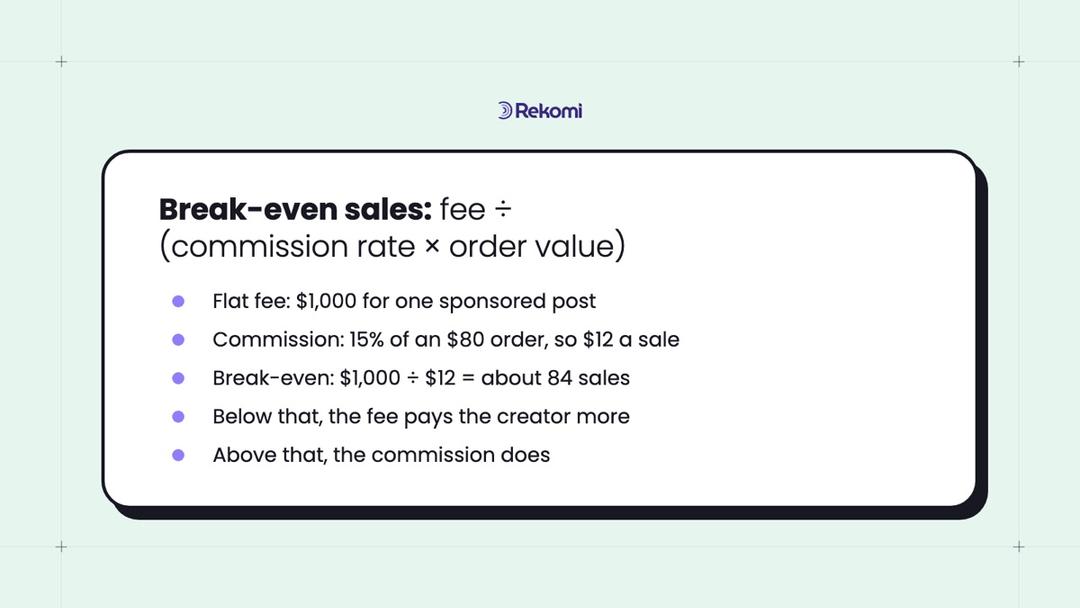
So, where do the two meet? The fee and the commission pay the creator the same amount at break-even sales = fee ÷ (commission rate × order value). For this deal that’s $1,000 ÷ $12, so about 84 sales. A creator who believes they’ll sell more than that should want the commission, and one who expects fewer should want the fee.
I love that the whole negotiation fits in one division, because it means you and the creator can do the math together instead of guessing at each other.
How do you combine influencer marketing with affiliate tracking?
You combine them by paying a smaller fee up front and a commission on tracked sales afterward (some teams call this influencer affiliate marketing), with a link and a code that belong to that creator. On the example above, $400 plus 15% pays the creator $508 on 9 sales, and it keeps paying on every sale after that, with no ceiling.
What each side gets: the creator has a guaranteed floor and a reason to mention you again next month. You pay less up front, and the extra you pay only exists when sales do. On a subscription product the commission can recur, which turns one video into income the creator still sees a year later!
The tracking is the easy part now, since a personal link catches the people who click and a personal discount code catches everyone who heard about you in a video and typed your name into a browser later (the mechanics are in my guide to influencer discount codes).
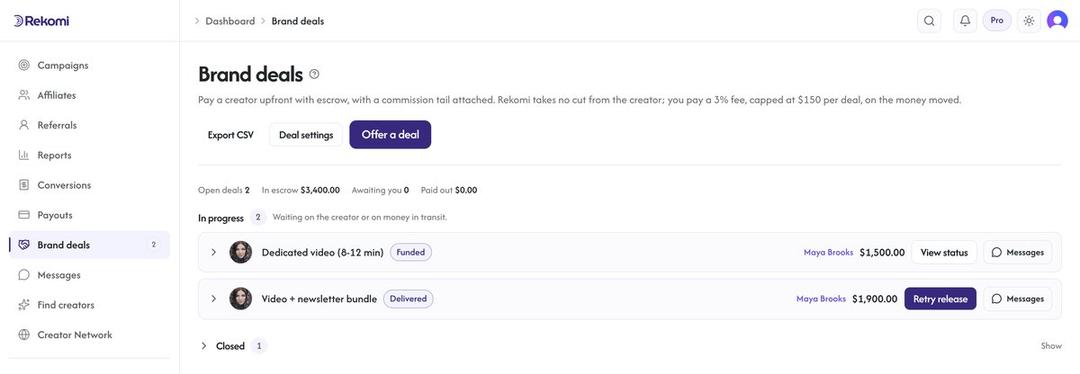
In Rekomi, that whole arrangement is called a brand deal, and it acts kind of like Upwork. Here’s how it works: you offer a creator a flat amount for a specific piece of work, the money is held in escrow until you confirm the work is live or the review window runs out (seven days by default), and an optional commission tail keeps paying them a percentage of tracked sales afterward.
Rekomi takes no cut from the creator. On a deal you arranged yourself you pay a 3% service fee, with a $5 minimum and a $150 cap, and the first deal with a creator you found in Rekomi’s directory carries a one-time 10% match fee capped at $500 instead.
Usage rights: whichever way you pay, put in writing who can reuse the content, where and for how long. It’s the term both sides most often assume and never say out loud.
Which should a new brand start with?
If you’re weighing influencer marketing vs affiliate marketing with no sales data yet, start with commission, because it costs nothing until it works and it tells you which audiences convert. Recruit customers and small creators who already use the product, give each one a link and a code, and watch for a month.
Then spend fees where the data points. When a creator’s commission numbers show their audience buys, a flat fee for a bigger piece of content from that same person is a very safe bet, since you’ve already seen the conversion rate. It’s hard to call this a rule for everyone, though, because fees do buy awareness faster. But a brand with no conversion data is guessing at every fee it pays, and commission is how you stop guessing.
Frequently asked questions
Is affiliate marketing the same as influencer marketing?
No. Affiliate marketing pays a commission after a tracked sale, and influencer marketing pays a fee for content whether or not it sells. They overlap in practice, since many influencers also carry affiliate links, but the payment model and the way you measure success are different.
Are influencers affiliates?
Yes, when they’re paid per sale through a link or a code. An influencer who earns commission on tracked sales is doing affiliate marketing, whatever their follower count. An influencer paid a flat fee for a post isn’t an affiliate for that deal, and plenty of creators work both ways with different brands.
Can you run affiliate and influencer marketing together?
Yes, and many established programs do. The common structure is a reduced flat fee for the content plus a commission on tracked sales, with a personal link and discount code for the creator. The fee pays for the work, and the commission rewards the creator for sales that keep arriving after the post.
How much do influencers make from affiliate links?
An influencer earns the commission rate times the order value times the number of sales. At 15% on an $80 order, that’s $12 a sale, so 100 sales from one video is $1,200. Recurring commissions on subscriptions add to that every month the customer stays, which is why creators whose audiences buy often prefer commission.
What is the difference between an affiliate and a brand ambassador?
An affiliate is paid per sale and has no obligation to post. A brand ambassador commits to representing the brand over a set period, usually in exchange for free product, perks and a personal code, and often earns commission too. Ambassadors are normally existing customers, and affiliates don’t have to be.
Do affiliates and influencers both have to disclose the relationship?
Yes. In the US, the FTC’s Endorsement Guides say a material connection has to be disclosed clearly, and that covers a commission link, a flat fee and free product alike. A plain label such as “ad” or “I earn a commission” near the recommendation does it, and brands are expected to tell their partners so.
Price your next creator as a fee and as a commission
Take the next creator on your list and write down two numbers: the fee they’d ask for, and that fee divided by your commission per sale. The second number is how many sales they’d need for commission to pay them the same. If it looks reachable, offer the commission with a small fee on top. If it’s far out of reach, you’re buying reach and content, so price it like an ad and ask for the usage rights.
Rekomi keeps the link, the code and the escrow on one deal, so the fee and the commission for a creator sit side by side. You can start the free trial and send your first offer the same afternoon.
Start a free trial

